XBRL FILING OF FINANCIAL STATEMENTS UNDER THE COMPANIES ACT, 2013: A COMPLETE GUIDE
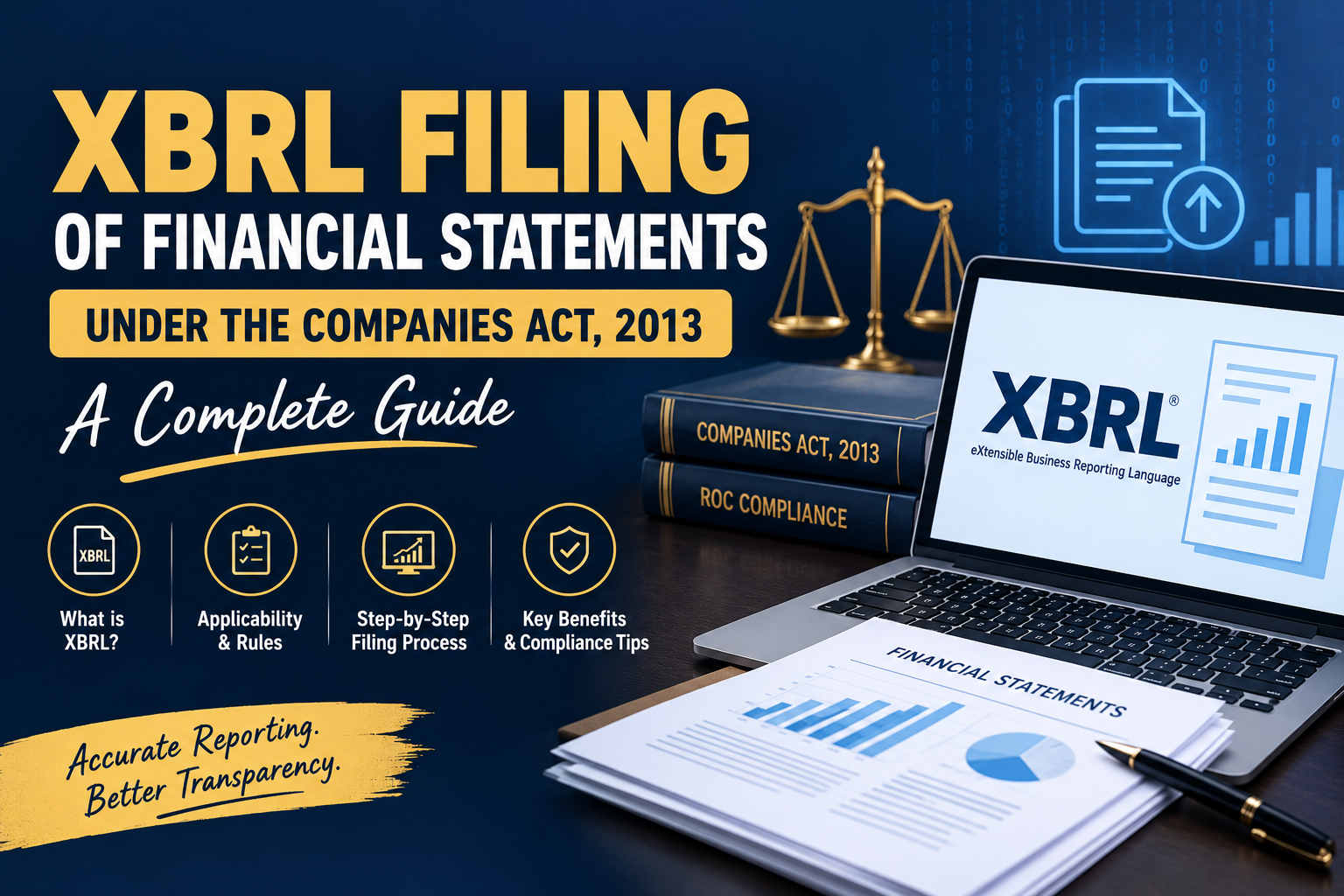
Ever wondered how companies report their financial information digitally? XBRL (eXtensible Business Reporting Language) makes financial reporting more structured, accurate and transparent. Under the Companies Act, 2013, specified companies must file their financial statements with the Registrar of Companies (ROC) in this standardised format. This blog explains the key legal provisions, filing requirements, procedures, deadlines and consequences of non-compliance.
What Is XBRL?
XBRL stands for eXtensible Business Reporting Language. It is a digital format that helps companies report their financial information in a standard way. In simple terms, XBRL converts financial details into a format that computers can easily read, understand and compare. For example, when a company prepares its Balance Sheet and Profit and Loss Statement, it must file these details in XBRL format if it falls under the applicable rules. This helps the Ministry of Corporate Affairs (MCA) process and compare financial information more easily and efficiently.
What are the Legal Provisions Governing XBRL Filing ?
XBRL filing is governed by the following provisions:
1. Section 137 of the Companies Act, 2013
Section 137 deals with filing copies of financial statements with the Registrar of Companies. Companies must comply with the applicable filing requirements and timelines.
2. Section 134 of the Companies Act, 2013
Section 134 deals with the approval and authentication of financial statements and the Board’s Report, along with related requirements.
3. Companies (Filing of Documents and Forms in Extensible Business Reporting Language) Rules, 2015
Note- Companies must follow the applicable provisions, rules and MCA filing instructions.
Which Companies Are Required to File Financial Statements in XBRL?
Under Rule 3 of the Companies (Filing of Documents and Forms in Extensible Business Reporting Language) Rules, 2015, the following categories of companies are generally covered:
- Listed companies: Companies listed on Indian stock exchanges and their Indian subsidiaries, as covered by the Rules.
- Companies with paid-up capital of ₹5 crore or more: Companies meeting the prescribed paid-up capital threshold.
- Companies with turnover of ₹100 crore or more: Companies meeting the prescribed turnover threshold.
- Companies covered under the applicable Ind AS requirements: Companies required to prepare financial statements under the Companies (Indian Accounting Standards) Rules, 2015, subject to the applicable provisions and exemptions.
- Previously covered companies: Companies that were required to file financial statements under the earlier XBRL Rules, as provided under the applicable rules.
Note- Before filing, companies should verify their applicability based on the relevant financial year, their company category and the latest MCA requirements.
Are Any Companies Exempt from XBRL Filing?
Certain categories are exempt from filing financial statements under the XBRL Rules, including:
- Banking companies
- Insurance companies
- Non-Banking Financial Companies (NBFCs)
What Is Form AOC-4 XBRL?
Form AOC-4 XBRL is an online form used by certain companies to submit their financial statements to the Registrar of Companies (ROC). Companies required to follow XBRL rules must enter their financial details in a special digital format that computers can read and understand. They must then upload the form on the Ministry of Corporate Affairs (MCA) portal along with the required documents, such as the signed financial statements, Board’s Report and Auditor’s Report. Before submitting the form, companies should check the latest MCA guidelines to ensure that all the necessary details and documents are included.
What Is the Due Date for XBRL Filing?
Under Section 137 of the Companies Act, 2013, companies are generally required to file their financial statements with the ROC within 30 days of the Annual General Meeting (AGM). For XBRL filing, companies must use the prescribed Form AOC-4 XBRL and comply with the applicable filing requirements. If the AGM is not held, the company must follow the applicable statutory provisions for calculating the filing deadline. Companies should plan their compliance in advance to avoid last-minute errors or delays.
What are the Documents Required for XBRL Filing ?
The documents required may vary depending on the company’s circumstances and the applicable MCA instructions. They generally include:
- Financial statements for the relevant financial year
- Notes to accounts and other applicable disclosures
- Board’s Report
- Auditor’s Report
- Cash Flow Statement, where applicable
- Consolidated financial statements, where applicable
- Other supporting documents prescribed for the filing
Advantages of XBRL Filing
XBRL filing provides several benefits for companies and regulators.
1. Better accuracy: Structured reporting and validation help identify inconsistencies and reduce data-entry errors.
2. Greater transparency: Financial information is presented in a standardised format, supporting clearer reporting.
3. Easy comparison: Financial data from different companies can be analysed more efficiently.
4. Faster processing: Electronic data can be processed more easily than information contained only in unstructured documents.
5. Improved compliance: A standard reporting framework helps companies organise their financial reporting and statutory filing processes.
Consequences of Delay or Non-Compliance in XBRL Filing
1. Additional Filing Fees: Late filing of financial statements may result in additional fees under the applicable rules.
2. Penalties: Depending on the nature of the default, the company and the officers responsible may face statutory penalties under the Companies Act, 2013.
3. Rejection or Resubmission: Incorrect information, errors in the XBRL file or missing documents may lead to rejection or a requirement to resubmit the form.
4. Delay in Compliance: Errors or incomplete documents can delay the completion of the filing process.
5. Importance of Timely Filing: Companies should check whether XBRL filing applies to them, ensure that financial information is accurate and submit all required documents within the prescribed deadline.
Common Mistakes to Avoid During XBRL Filing
Companies should take care to avoid the following mistakes:
- Selecting the wrong XBRL taxonomy or reporting period
- Using incorrect financial tags
- Providing inconsistent financial figures
- Failing to attach the required signed documents
- Using an incorrect or incomplete form
- Missing the statutory filing deadline
- Ignoring MCA validation errors or resubmission notices
Conclusion
From XBRL filing and financial statement submissions to a wide range of company compliance requirements, CorpBuddy, Raipur is here to simplify compliance for your business. Let us help you navigate complex legal formalities, meet statutory obligations and keep your business on track. Don’t let compliance slow your growth. Contact CorpBuddy, Raipur today and let us handle your company compliance needs while you focus on growing your business!
Frequently Asked Questions (FAQs)
1. What is XBRL filing under the Companies Act, 2013?
XBRL filing is the submission of financial statements in a structured electronic format by companies covered under the applicable XBRL Rules.
2. Which form is used for XBRL filing?
Form AOC-4 XBRL is used for filing financial statements in XBRL format by companies covered under the relevant requirements.
3. What is the due date for filing financial statements?
Under Section 137, the general deadline is 30 days from the date of the AGM, subject to the applicable statutory provisions.
4. Is every company required to file financial statements in XBRL format?
No. XBRL filing applies to specified classes of companies under Rule 3 of the XBRL Rules, subject to applicable exemptions.
5. What is the difference between AOC-4 and AOC-4 XBRL?
AOC-4 is the prescribed form used for filing financial statements in the applicable non-XBRL filing process, while AOC-4 XBRL is used for filing financial statements in XBRL format by companies covered under the XBRL requirements.
6. What happens if a company files its financial statements late?
Late filing may attract additional fees and statutory consequences under the Companies Act, 2013 and applicable rules.
7. Why is XBRL important for corporate compliance?
XBRL supports standardised financial reporting, improves data analysis and helps the MCA process financial information more efficiently.
WRITTEN BY IPSHITA GHOSH (B.A.LL.B) 7TH SEMESTER
By entering the email address you agree to our Privacy Policy.