MOA VS AOA: KEY DIFFERENCES EVERY BUSINESS OWNER SHOULD KNOW
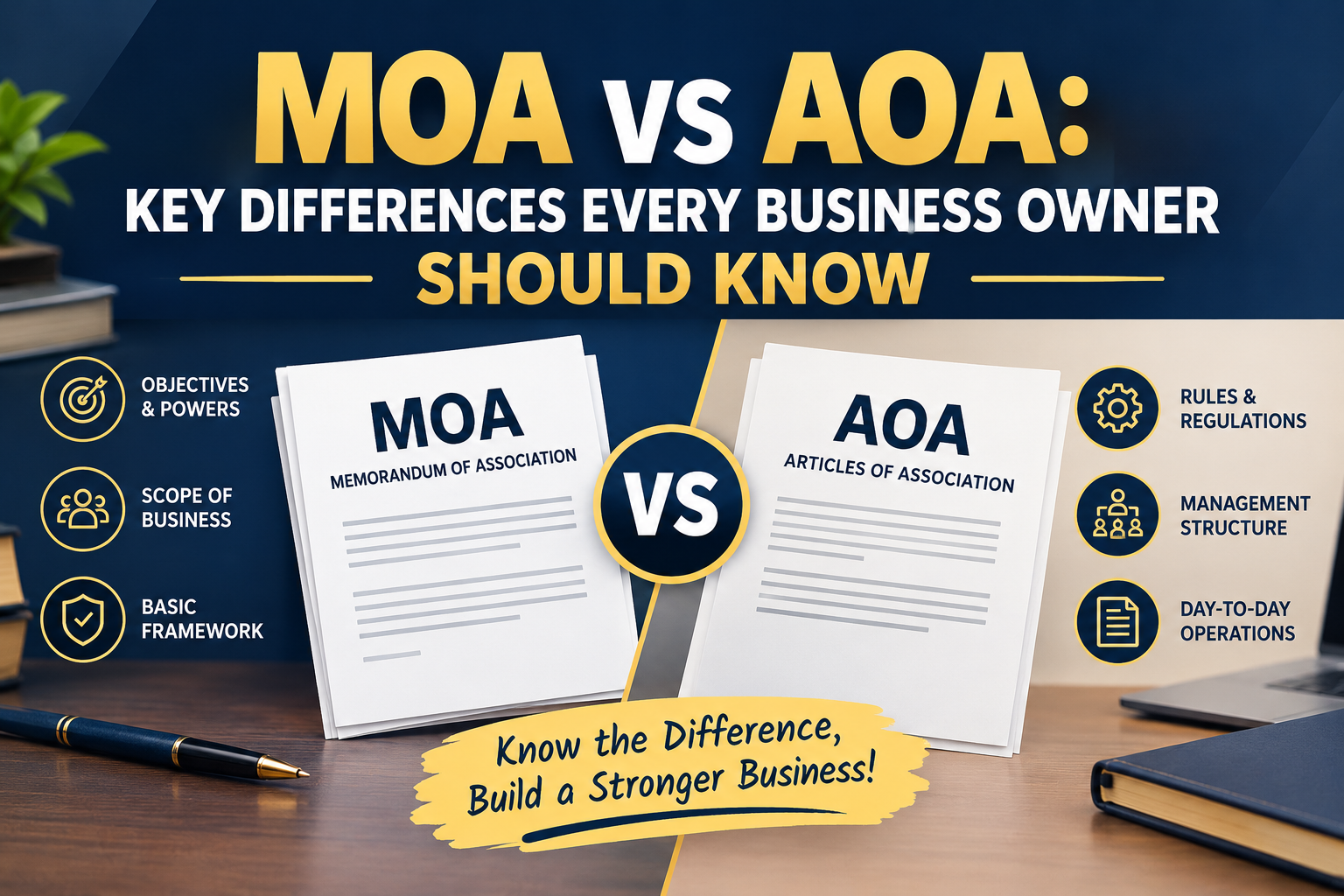
Starting a company involves more than choosing a name and completing registration. Two important documents form the foundation of how a company operates: the Memorandum of Association (MOA) and the Articles of Association (AOA). Although both documents are filed during company incorporation, they serve different purposes. In simple terms: MOA tells you what a company can do. AOA tells you how the company will do it. Understanding the difference between MOA and AOA can help business owners, directors and shareholders understand their company’s legal structure and internal functioning.
What Is an MOA?
The Memorandum of Association (MOA) is one of the fundamental documents of a company. It defines the company’s scope and objectives and sets the basic framework within which the company operates. Think of the MOA as the boundary of the company. It helps answer important questions such as:
- What is the company’s name?
- Where is its registered office?
- What business activities can it undertake?
- What is its authorised share capital?
- Who are its initial subscribers?
Example of an MOA
Suppose ABC Foods Private Limited is incorporated to manufacture and sell food products. If the company’s stated objects cover food manufacturing and related activities, the company should ensure that its activities remain within the permitted scope. The MOA therefore provides an important framework for the company’s external activities.
What Is an AOA?
The Articles of Association (AOA) contain the rules and regulations governing the company’s internal management. If the MOA establishes the company’s boundaries, the AOA explains how the company will function within those boundaries. It provides a framework for the company’s day-to-day management and decision-making and may cover matters such as:
- Appointment and powers of directors
- Conduct of board meetings
- Share transfer procedures
- Voting rights
- Payment and declaration of dividends
- General meetings
- Decision-making procedures
- Internal management of the company
MOA vs AOA: What Is the Difference?
| Basis | MOA | AOA |
| Full Form | Memorandum of Association | Articles of Association |
| Main Purpose | Defines the company’s scope and objectives | Defines internal rules and management |
| Focus | External boundaries | Internal functioning |
| Deals With | Company’s permitted activities and fundamental structure | Management and operational procedures |
| Nature | Fundamental constitutional document | Internal rulebook |
| Example | What business the company can undertake | How directors and shareholders make decisions |
Why Is the MOA Important?
- Defines the Company’s Objectives– The MOA sets out the company’s objects and provides a framework for its business activities.
- Establishes the Company’s Basic Structure– It contains important information relating to the company’s identity, registered office, capital and subscribers.
- Provides a Legal Boundary– The MOA helps establish the scope within which the company is expected to operate. For this reason, business owners should carefully consider the company’s proposed activities while preparing the MOA.
- Builds Investor Confidence – A clear MOA helps investors understand the company’s purpose and proposed activities before putting their money into the business.
- Helps Define Shareholder Commitment – It records the details and commitments of the company’s initial subscribers, creating clarity from the beginning.
- Supports Future Business Planning – A properly drafted MOA can provide a useful foundation when the company expands or changes its business activities.
Why Is the AOA Important?
- Provides Internal Rules– The AOA establishes rules for managing the company’s internal affairs.
- Helps Directors and Shareholders-It provides procedures for matters such as meetings, voting, appointment of directors and transfer of shares.
- Reduces Internal Conflicts- Clearly defined procedures can make decision-making easier and reduce misunderstandings between shareholders and directors. For example, if shareholders want to transfer shares, the AOA may contain provisions explaining the procedure that must be followed.
- Builds Investor Confidence – A clear MOA helps investors understand the company’s purpose and proposed activities before putting their money into the business.
- Helps Define Shareholder Commitment – It records the details and commitments of the company’s initial subscribers, creating clarity from the beginning.
- Supports Future Business Planning – A properly drafted MOA can provide a useful foundation when the company expands or changes its business activities.
How Do MOA and AOA Work Together?
The MOA and AOA are not competing documents; they work together to provide the company with a clear legal and operational framework. Think of starting a company like planning a journey: the MOA defines where the company can go, while the AOA sets out the rules for how the company operates during that journey.
For example, suppose ABC Technologies Private Limited is incorporated to provide software development and IT consulting services. The MOA may state that the company is formed to undertake technology-related business activities. The AOA, on the other hand, may contain rules regarding the appointment and powers of directors, procedures for board meetings, voting rights of shareholders, transfer of shares and approval of important business decisions.
Can the MOA and AOA Be Changed?
Yes, both the MOA and AOA can be changed, but the process is not always the same. As a company grows, its business activities, ownership structure or internal management requirements may change. In such situations, the company may need to alter certain provisions of its MOA or AOA in accordance with the Companies Act, 2013. However, the required approvals, resolutions and filings can differ depending on the nature of the proposed change. Therefore, companies should follow the prescribed legal procedure and properly document the changes rather than making informal amendments.
Which Has Greater Authority: MOA or AOA?
The MOA generally has greater authority than the AOA because the AOA must remain consistent with the MOA and the applicable provisions of company law. If any provision of the AOA conflicts with the MOA, the conflicting provision cannot override the company’s fundamental constitutional framework. Similarly, neither the MOA nor the AOA can override the mandatory provisions of the Companies Act, 2013. This is why both documents should be carefully prepared and regularly reviewed to ensure that the company’s activities and internal rules remain legally compliant.
Quick Example
Imagine a company called XYZ Technologies Private Limited. Its MOA establishes that the company is formed to undertake technology-related business activities.
Its AOA may then establish:
- How directors are appointed
- How board meetings are conducted
- How voting takes place
- How shares can be transferred
- How shareholders’ meetings are organised
Conclusion
The MOA defines what your company can do, while the AOA explains how it operates. Together, they create the legal foundation for your business. Getting them right from the beginning can prevent future confusion and compliance issues. CorpBuddy, Raipur helps businesses with company registration, documentation and compliance, so you can focus on growth.
FAQ
1. What is the fundamental purpose of an MOA?
The MOA defines the company’s legal boundary, purpose, and relationship with the outside world.
2. What is the fundamental purpose of an AOA?
The AOA sets the internal rules, regulations, and operational procedures for managing the company.
3. Which document holds higher authority if a conflict arises between them?
The MOA always holds higher authority and overrides any conflicting terms in the AOA.
4. What happens legally if a company acts beyond its MOA limits?
The action is “ultra vires” and legally void, meaning it cannot be approved or ratified even by all shareholders.
5. Which document is easier to modify after incorporation?
The AOA is much easier to modify, requiring only an internal special resolution by shareholders.
WRITTEN BY IPSHITA GHOSH (B.A.LL.B)
By entering the email address you agree to our Privacy Policy.