TRADEMARK VS COPYRIGHT VS PATENT IN RAIPUR: WHICH IP PROTECTION DO YOU NEED?
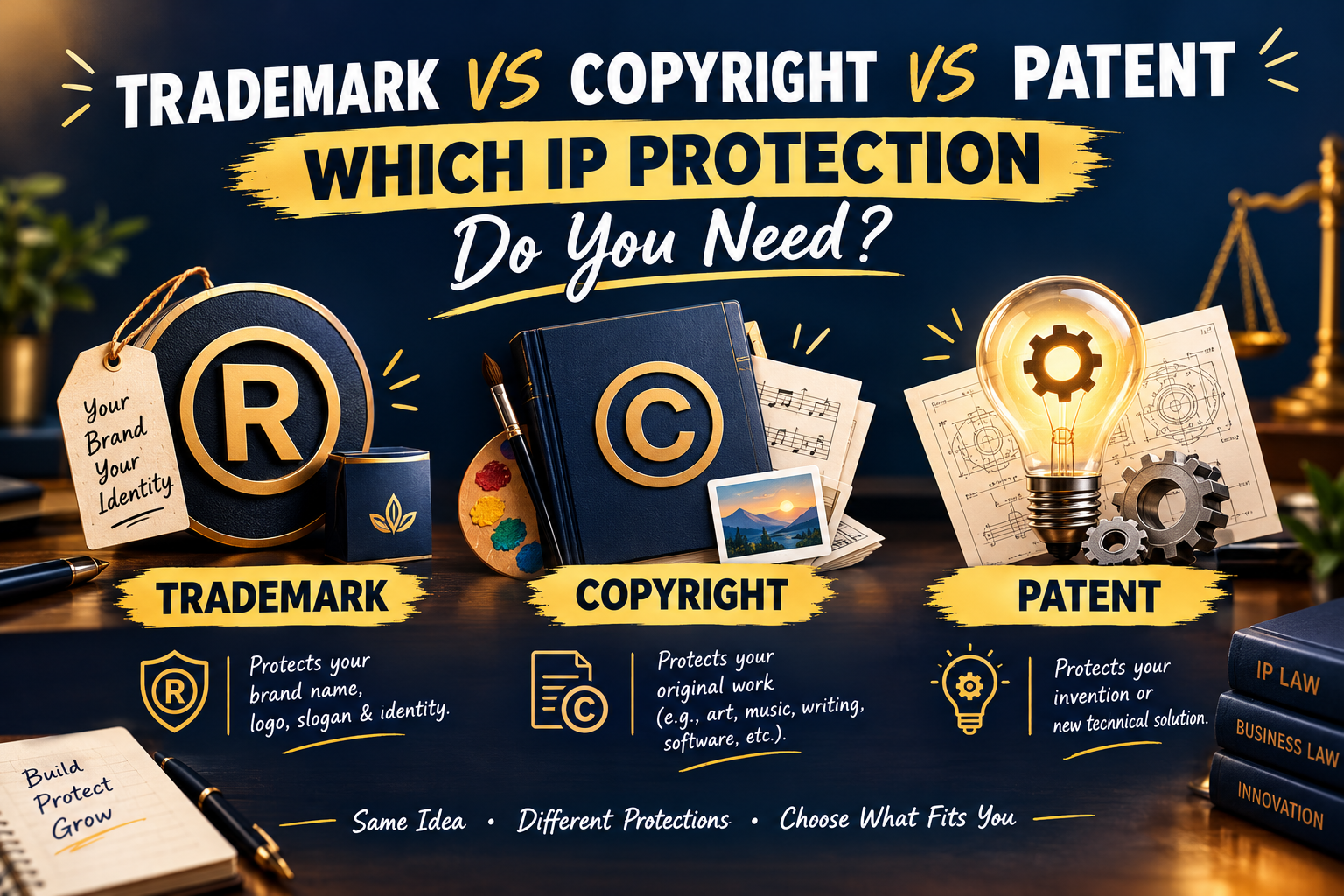
What if you woke up tomorrow and found someone else using your brand name, copying your content, or claiming your invention as their own? You’ve spent time, money, and creativity building something valuable. But creating it is only the first step—protecting it is what helps you keep control. That’s where Intellectual Property (IP) protection comes in. The challenge is knowing which protection applies to what you’ve created. Trademark protects your brand, Copyright protects your creative work, and Patent protects your invention. Understanding the difference can help you safeguard your work, protect your business, and take action before a small IP issue becomes a costly problem.
What is Intellectual Property?
Intellectual Property (IP) means creations of the human mind that have legal and commercial value. It covers things that a person or business creates, develops, designs, writes, invents, or uses to identify their products and services. IP can include brand names, logos, slogans, product designs, books, articles, photographs, paintings, music, films, videos, software and computer programs, inventions, industrial designs, geographical indications, and confidential business information or trade secrets. For example, if you start a clothing brand called “Urban Vogue,” the brand name and logo may be protected as a Trademark. If you create original photographs or advertisements for the brand, they may receive Copyright protection. If you develop a new technology used in your clothing product, it may qualify for Patent protection. Similarly, the unique design or appearance of a product may be protected through Design rights, where the legal requirements are satisfied.
What Does Intellectual Property Include?
Intellectual Property (IP) means creations of the human mind that have commercial or creative value and can receive legal protection. The major types of IP include:
- Trademark – Protects signs that identify a business or its products/services. Includes: Brand names, logos, symbols, taglines, slogans, product names, service marks, and sometimes distinctive shapes, packaging, colours or sounds.
- Copyright – Protects original creative expressions, not merely ideas. Includes: Books, articles, photographs, paintings, music, songs, films, videos, sound recordings, software/computer programs, website content, drawings and other artistic or literary works.
- Patent – Protects a new, inventive and industrially applicable invention, subject to legal requirements. Includes: New products, machines, devices, technologies, manufacturing processes and certain technical improvements.
- Industrial Design – Protects the visual appearance of a product, rather than its technical function.
Includes: Shape, configuration, pattern, ornamentation, lines, colours or combination of these features applied to a product. - Geographical Indication (GI) – Identifies products that come from a specific geographical area and have a particular quality, reputation or characteristic linked to that place.
Includes: Products such as Darjeeling Tea, Banarasi Sarees, Kanchipuram Silk and Chhattisgarh’s Jeeraphool Rice. - Trade Secrets / Confidential Information – Protects valuable business information that is kept secret and gives a business a competitive advantage. Includes: Secret formulas, recipes, manufacturing methods, business strategies, pricing information, customer lists, supplier information and confidential technical know-how.
What Is a Trademark and Why Does Your Brand Need One?
A Trademark protects the identity that helps customers recognise and distinguish your business, products or services from others.
What things can fall under a Trademark?
- Brand name – the name of your company or product.
- Logo – the graphic or symbol used to represent your brand.
- Word – a unique word used as a brand.
- Tagline/Slogan – a distinctive phrase associated with your business.
- Letters or numbers – unique combinations used to identify a brand.
- Symbol or sign – a distinctive symbol representing your business.
- Product name – a particular name given to a product.
- Service name – a name used to identify a particular service.
- Shape or packaging – in certain cases, a distinctive product shape or packaging can function as a trademark.
- Sound – a distinctive sound associated with a brand may also be protected in appropriate cases.
Example: If you start a clothing business called “UrbanLeaf” and create a unique logo and tagline for it, these brand elements may be capable of trademark protection if they meet the legal requirements.
How Does Copyright Protect Your Creativity?
You created it. You wrote it. You designed it. So, who gets to use it? Copyright protects original creative work created by a person. In simple words, when you create something original through your skill and creativity, copyright can protect the way you have expressed that creation. What Can Copyright Protect?
Think of copyright as a legal shield for your creative work. It can cover:
- Books & Stories – novels, poems, stories and other original writings.
- Articles & Blogs – original articles, research-based writing and blog content.
- Photographs – original photographs and creative images.
- Music & Lyrics – original musical compositions and song lyrics.
- Films & Videos – movies, short films, videos and other cinematographic works.
- Paintings & Artwork – paintings, drawings, illustrations and other artistic works.
- Computer Programs – original computer code and software.
- Sound Recordings – recorded music, podcasts and other eligible audio recordings.
- Plays & Scripts – dramatic works, scripts and stage plays.
- Website Content – original text, graphics, photographs and other creative content.
- Illustrations & Creative Graphics – original visual and graphic works.
Where Does Copyright Protection Begin?
One of the most important principles of copyright is that copyright protects the expression of an idea, not the idea itself. In simple words, you may have a creative idea, but copyright generally does not give you exclusive rights over that basic idea. For example, you may think of a story about a young lawyer solving a mysterious case. Another person can also use a similar story idea. However, if you write your own original story, the specific words, characters, structure and manner in which you express the story may be protected by copyright. Therefore, the idea is the concept, while the expression is how you turn that concept into an original creative work.
Can Your Invention Be Patented?
You invented something new. But what stops someone else from copying it? A Patent gives legal protection to a qualifying invention. In simple words, it can give the inventor the exclusive right to make, use, sell or commercially exploit the patented invention, subject to the applicable law.
What Can a Patent Protect?
A patent may protect an invention such as:
- New products – a new machine, device or technical product.
- New processes – a new and useful method of manufacturing or doing something.
- Machines & mechanisms – innovative technical machinery or systems.
- Technical improvements – certain new and inventive improvements to existing technology.
- New technologies – qualifying technological inventions that meet the requirements of patent law.
- Certain pharmaceutical or chemical inventions – where they satisfy the applicable legal requirements.
However, not every new idea or creation can be patented. Generally, an invention must meet requirements such as novelty, inventive step and industrial applicability, and it must not fall within the exclusions under patent law. For example: If you develop a genuinely new machine that solves a technical problem in a new and inventive way, and it satisfies the legal requirements, you may be able to seek patent protection for it.
Trademark vs Copyright vs Patent: What’s the Difference?
| Point | Trademark | Copyright | Patent |
| 1. Meaning | Protects the identity of a brand. | Protects original creative expression. | Protects a qualifying invention. |
| 2. What it covers | Names, logos, symbols, slogans and taglines. | Books, articles, photos, music, films, artwork and software code. | New products, machines, technologies and technical processes. |
| 3. Main purpose | Helps customers recognise and distinguish a brand. | Prevents unauthorised use of original creative work. | Gives the inventor exclusive rights over the invention for a limited period. |
| 4. Example | A company’s unique name or logo. | An original photograph or article. | A new and inventive technical machine. |
| 5. Does not generally protect | Generic or non-distinctive marks. | Ideas themselves; it protects their expression. | Mere ideas that do not qualify as inventions. |
| 6. Common users | Businesses and brand owners. | Authors, artists, photographers, musicians and software creators. | Inventors, researchers and businesses. |
| 7. Duration in India | 10 years, renewable repeatedly. | Generally 60 years for many works, depending on the type. | Generally 20 years from the filing date. |
Can One Business Have All Three?
Yes. A business can use Trademark, Copyright and Patent protection at the same time, because each protects a different part of the business.
- Trademark: Protects the business’s brand name, logo, slogan or other distinctive marks.
- Copyright: Protects the business’s original creative content, such as website content, photographs, videos, software code and advertisements.
- Patent: Protects a qualifying new and inventive product, technology or technical process.
- They can work together: The same product can have different types of IP protection for its brand, creative content and technology.
Imagine you launch a skincare brand called “GlowUp.” Your brand name and logo can be protected by Trademark. Your product photos, website content and promotional videos can be protected by Copyright. If you develop a genuinely new technical formula or process that meets patent requirements, it may be protected by a Patent. One business, three layers of protection.
Common IP Mistakes Businesses Make
- Thinking one protection is enough – A trademark, copyright and patent protect different things, so one cannot protect everything.
- Not registering the brand – Simply using a business name or logo does not mean it is legally registered as a trademark.
- Thinking an idea is copyrighted – Copyright protects the way an idea is expressed, not the basic idea itself.
- Using someone else’s work without permission – Copying photos, music, videos, designs or content can lead to copyright problems.
- Sharing an invention too early – Publicly revealing an invention before considering patent protection may create problems for getting a patent.
- Not identifying valuable IP – Businesses may forget that their logo, website, software, designs and confidential information can also be valuable IP.
- Waiting too long to protect IP – Delaying protection can increase the risk of copying, misuse or disputes.
- Not deciding who owns the IP – Businesses should clearly decide who owns work created by employees, freelancers or outside professionals.
The 10-Second IP Test: Trademark, Copyright or Patent?
Not sure which IP protection you need? Just ask yourself: “What exactly am I trying to protect?”
- My Brand? → Trademark — Protects your name, logo, slogan or other distinctive brand identity.
- My Creative Work? → Copyright — Protects your original writing, photos, music, videos, artwork or software code.
- My Invention? → Patent — Protects a qualifying new and inventive product, technology or process.
Why Should Businesses Think About IP Early?
Your business may be small today, but your ideas can become its biggest assets tomorrow. A brand name, logo, original content, software, design or new technology can become valuable as your business grows. Thinking about IP early helps you protect what you create, avoid unnecessary disputes, reduce the risk of copying and build a stronger business.
Frequently Asked Questions (FAQs)
1. What is Intellectual Property?
Intellectual Property (IP) protects valuable creations such as brands, creative works, inventions, designs and confidential business information.
2. What is the difference between Trademark, Copyright and Patent?
Trademark protects your brand, Copyright protects your creative work, and Patent protects a qualifying invention.
3. Can one business have Trademark, Copyright and Patent protection?
Yes. A business can have all three because each protects a different part of the business or product.
4. Does Copyright protect an idea?
Generally, no. Copyright protects the original expression of an idea, not the basic idea itself.
5. Why should businesses protect their IP early?
Early protection can help businesses prevent unauthorised use, reduce disputes and protect valuable business assets as the business grows.
Conclusion
Your ideas deserve protection. Whether it’s your brand, creative work or invention, the right IP protection can help safeguard your business and its future. From choosing the right IP protection to assisting with Trademark, Copyright and Patent filing, CorpBuddy, Raipur makes the process simpler and easier. Get started with CorpBuddy, Raipur today and take the first step towards protecting your brand, creativity and inventions.
WRITTEN BY IPSHITA GHOSH 4TH YEAR (B.A.LL.B)
By entering the email address you agree to our Privacy Policy.