
ITR DUE DATE EXTENDED 2026: CBDT EXTENDS TAX AUDIT & ITR DEADLINES FOR AY 2026-27
Tax compliance deadlines are an important part of managing a business or profession. For taxpayers whose accounts are subject to tax audit, timely completion of the audit report and Income Tax Return (ITR) is especially important. For AY 2026–27, the CBDT has now provided additional time for completing these compliances.
Has CBDT Extended the Tax Audit & ITR Filing Deadlines?
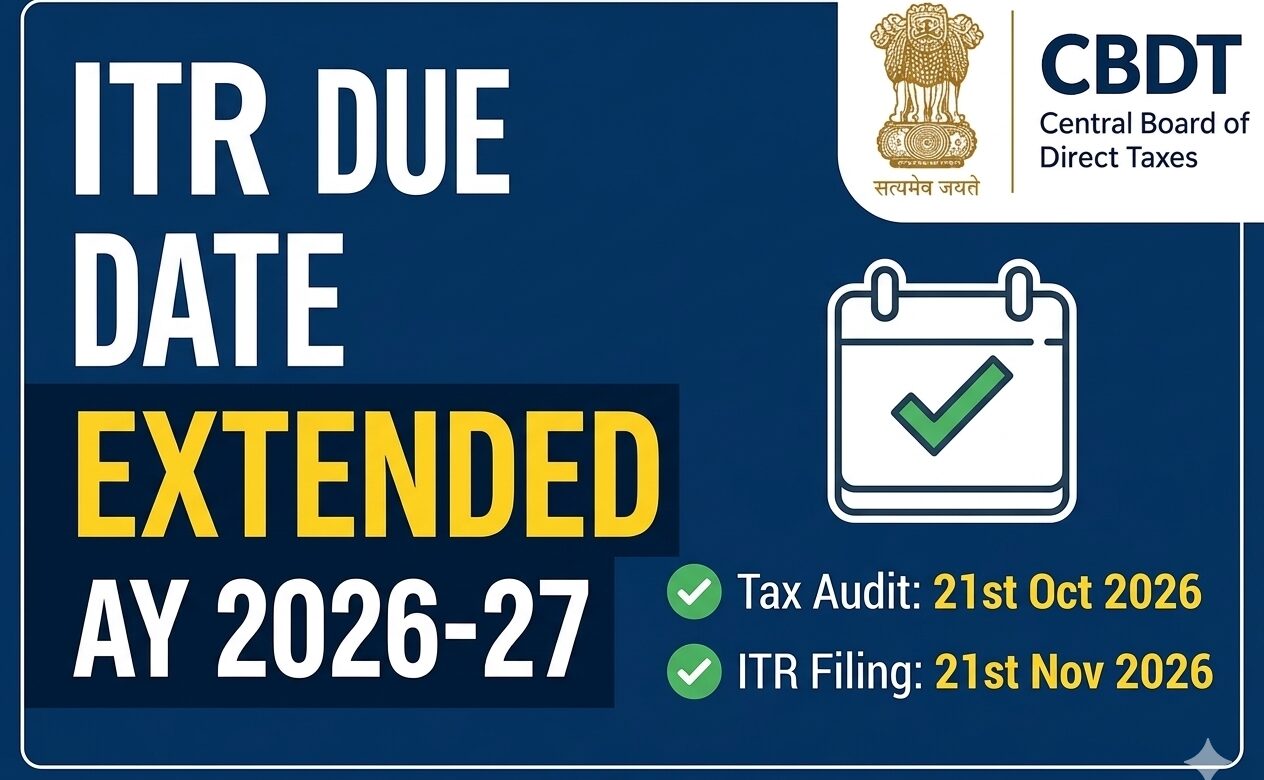
The Central Board of Direct Taxes (CBDT), through Circular No. 07/2026 dated 28 September 2026, has extended the due dates for filing the Tax Audit Report and the corresponding Income Tax Return (ITR) for the specified taxpayers covered under the relevant provisions of the Income-tax Act, 1961. Under the revised timeline, the Tax Audit Report deadline has been extended from 30 September 2026 to 21 October 2026. The ITR filing deadline has also been extended from 31 October 2026 to 21 November 2026. The extension gives eligible taxpayers and professionals additional time to complete the audit process, verify financial information and ensure that the required returns are filed correctly within the revised deadlines.Top of FormBottom of Form
What Has Changed?
The revised deadlines can be understood easily through the following table:
| Compliance Requirement | Earlier Due Date | Extended Due Date |
| Tax Audit Report | 30 September 2026 | 21 October 2026 |
| Income Tax Return | 31 October 2026 | 21 November 2026 |
Why Did CBDT Extend the Due Dates?
The extension provides taxpayers and professionals with additional time to complete the audit and ITR filing process. The key reasons are:
- Additional time for tax audit: Taxpayers and professionals get more time to complete the tax audit process.
- Time to finalise accounts: Businesses can complete and verify their books of accounts and financial statements.
- Completion of audit procedures: Chartered Accountants get additional time to examine the financial records and complete the required audit formalities.
- Preparation of the Tax Audit Report: The prescribed audit report and related information can be prepared and submitted within the extended deadline.
- Better reconciliation: Taxpayers can cross-check the figures in their books, Tax Audit Report and ITR to reduce discrepancies.
- Accurate ITR filing: The additional time allows taxpayers to prepare and file their Income Tax Return with greater accuracy.
- Reduced last-minute pressure: The extension can help taxpayers and professionals avoid rushing through multiple connected compliance requirements.
What is a Tax Audit?
A tax audit is a process in which a Chartered Accountant (CA) checks the financial records of certain businesses and professionals to ensure that their income, expenses and tax-related information are properly recorded and reported. Where applicable, the CA prepares the required Tax Audit Report, which may include Form 3CA/3CB and Form 3CD.
Example: If a business is required to undergo a tax audit for FY 2025–26, its CA will examine its books of accounts, verify its income and expenses, and prepare the required audit report before the applicable filing deadline.
Who Needs to Pay Attention to These Revised Dates?
- Taxpayers covered by tax audit: The revised dates mainly apply to taxpayers whose accounts are required to be audited under income-tax law.
- Eligible businesses: Businesses that meet the applicable conditions for tax audit should follow the revised deadlines.
- Professionals: Certain professionals whose accounts are subject to tax audit are also covered.
- Tax Audit Report filers: Taxpayers required to submit a Tax Audit Report should note the new 21 October 2026 deadline.
- ITR filers in the specified category: The corresponding ITR deadline for the covered taxpayers is 21 November 2026.
- Not applicable to everyone: The extended deadlines do not automatically apply to every taxpayer. The applicable due date depends on the taxpayer’s category and tax obligations.
- Check your category first: Taxpayers should confirm whether they fall under the category covered by the CBDT extension before relying on the revised dates.
Does the Extension Apply to Everyone?
No, the extension does not apply to every taxpayer. It mainly covers taxpayers whose accounts are required to be audited under the income-tax law, such as certain businesses, professionals and other specified taxpayers. The extension is for the category covered under Section 139(1), Explanation 2, Sl. No. 2 of the Income-tax Act, 1961. Therefore, taxpayers should check whether they fall under this category before relying on the revised 21 November 2026 ITR deadline.
What Should Businesses Do Now?
Although the deadlines have been extended, businesses should continue preparing their filings without waiting for the revised last dates.
- Finalise books of accounts– Ensure that income, expenses, assets, liabilities and other financial records are properly updated.
- Complete the tax audit– Where tax audit is applicable, coordinate with the Chartered Accountant and provide the required records and supporting documents.
- Verify the Tax Audit Report– Before submission, check important financial and tax-related information carefully.
- Prepare the ITR– The appropriate ITR form should be selected based on the taxpayer’s circumstances.
- Reconcile the information– Figures reported in the financial statements, tax audit report, ITR and other relevant records should be consistent.
- File before the revised deadline– Even with the extension, filing early can reduce the risk of last-minute technical problems or documentation issues.
Why Accurate Filing Matters ?
- Correct information is important: The ITR should match the taxpayer’s actual financial records.
- Figures should be consistent: Turnover, income and expenses reported in the books, Tax Audit Report and ITR should match.
- Avoid unnecessary queries: Incorrect or mismatched information can lead to questions from the tax department.
- Reduce compliance problems: Accurate filing helps businesses avoid errors and possible complications later.
- Use the extra time properly: The extended deadline should be used to review, verify and reconcile records, not simply to delay filing.
Conclusion
Keeping up with changing tax deadlines can be difficult, especially when tax audits and ITR filing are closely connected. CorpBuddy, Raipur helps businesses and professionals stay on top of their tax compliance by providing support with ITR filing, tax audit-related requirements and other business compliance needs, making the overall process simpler and more organised.
Frequently Asked Questions (FAQs)
- What is the new ITR filing due date for audit cases for AY 2026–27?
For the specified taxpayers covered by the CBDT extension, the ITR filing due date has been extended from 31 October 2026 to 21 November 2026. - What is the new tax audit report due date for AY 2026–27?
The Tax Audit Report due date has been extended from 30 September 2026 to 21 October 2026 for the specified taxpayers covered by the extension. - Has the ITR due date been extended for everyone?
No. The extension applies to the specified category of taxpayers covered by the CBDT circular. Taxpayers should check their applicable category before relying on the revised date. - What is the difference between the tax audit deadline and ITR deadline?
The Tax Audit Report must be furnished first where tax audit is applicable. For the specified AY 2026–27 cases, the revised audit-report deadline is 21 October 2026, while the revised ITR deadline is 21 November 2026. - Why did CBDT extend the ITR filing deadline for audit cases?
The extension provides additional time for taxpayers and professionals to complete tax audit-related compliance and subsequently prepare and file the income-tax return. - Who needs to file a Tax Audit Report?
Taxpayers whose accounts are required to be audited under the applicable provisions of the Income-tax Act need to furnish a Tax Audit Report. Whether tax audit applies depends on the taxpayer’s nature of business or profession and the applicable statutory conditions. - What happens if I miss the extended ITR deadline?
Missing the applicable deadline can lead to consequences under the Income-tax Act, including applicable late-filing consequences. The exact consequences depend on the taxpayer’s circumstances. - Does the extension change the Tax Audit Report requirement?
No. The extension changes the deadline, not the underlying requirement to furnish the Tax Audit Report where tax audit is applicable. - What should businesses do before filing their ITR?
Businesses should finalise their books, complete the applicable tax audit, verify the Tax Audit Report, reconcile financial information and ensure that the figures reported in the audit documents and ITR are consistent.
WRITTEN BY IPSHITA GHOSH 4TH YEAR (B.A.LL.B)
By entering the email address you agree to our Privacy Policy.