Big MCA Relief! AOC-4, MGT-7 & MGT-7A Filing Deadlines Extended for FY 2025–26
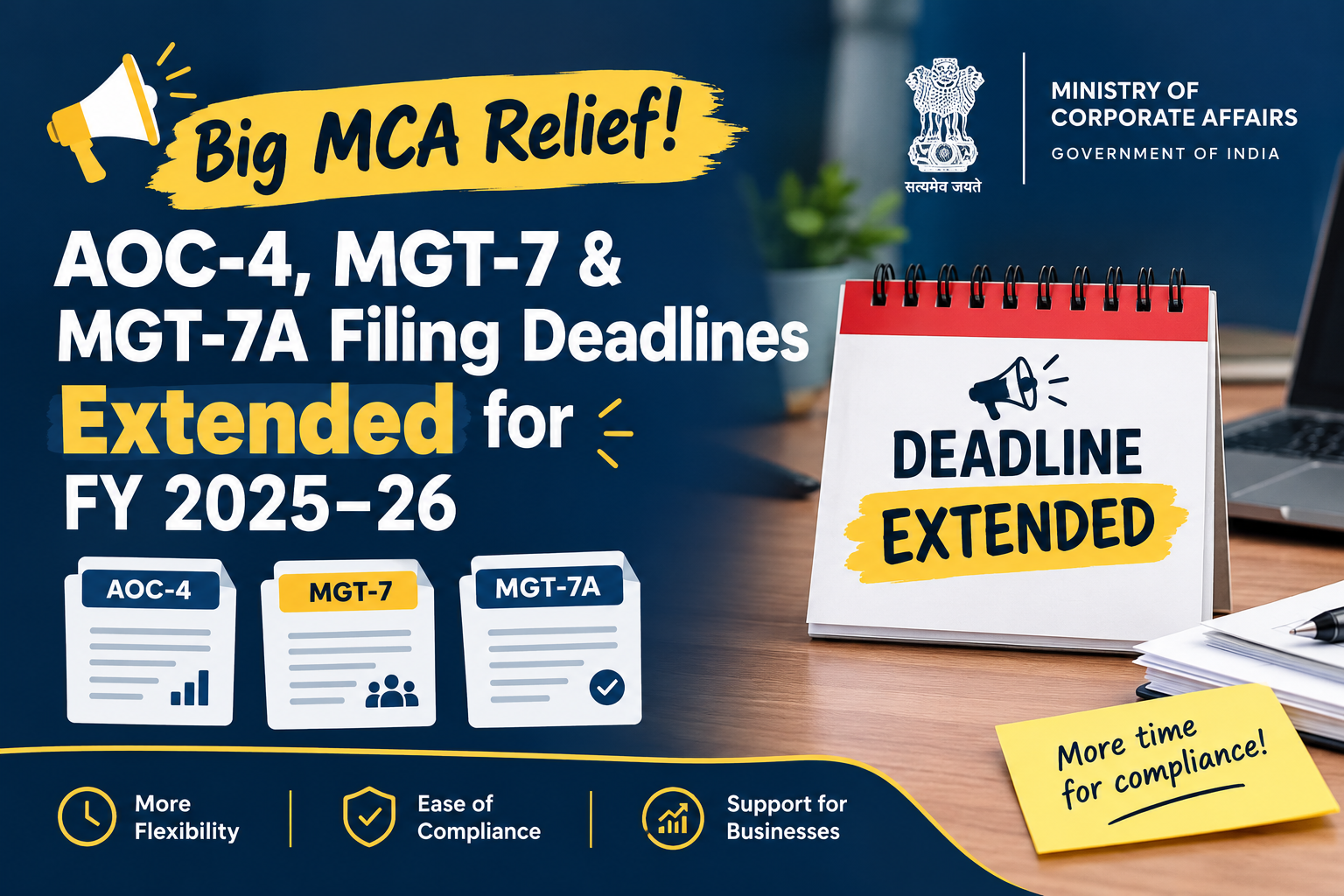
Struggling to complete your company’s annual ROC filings on time? There’s good news! The Ministry of Corporate Affairs (MCA) has extended the filing deadlines, giving businesses more time to organise documents, verify records and complete compliance without additional fees within the extended period. Let’s understand the revised deadlines and key requirements.
Revised Due Dates for Annual ROC Filing
| Form | Purpose | Extended Due Date |
| AOC-4 | Filing financial statements | 31 December 2026 |
| MGT-7 | Filing annual returns | 31 January 2027 |
| MGT-7A | Simplified annual return for eligible companies | 31 January 2027 |
These dates apply to the specified filings for FY 2025–26. Companies should identify the correct form and complete the filing before the extended deadline.
What is Form AOC-4?
Form AOC-4 is used by a company to submit its financial statements to the Registrar of Companies (ROC). In simple words, it tells the government about the company’s financial position and performance during the financial year.
The financial statements generally include:
- Balance Sheet: Shows the company’s assets, liabilities and financial position.
- Profit and Loss Statement: Shows the company’s income, expenses, profit or loss.
- Other required documents: These may include the auditor’s report, Board’s report and other applicable attachments.
What is the new due date?
Under the MCA circular, the deadline for filing AOC-4 for FY 2025–26 has been extended to 31 December 2026, without additional fees during the extended period.
What should companies do?
Companies should prepare their financial statements, complete the necessary approvals and check that all details and attachments are correct before filing. Depending on the company’s reporting requirements, a different version, such as AOC-4 CFS or AOC-4 XBRL, may apply.
Example: If a company is preparing its financial statements for the year ending 31 March 2026, it can use the extended deadline to complete its applicable AOC-4 filing by 31 December 2026.
What is Form MGT-7?
Form MGT-7 is used by companies to file their annual returns with the ROC. It provides important information about the company and its management.
The form generally contains details such as:
- Company’s registered office and principal business activities.
- Information about directors and key managerial personnel, where applicable.
- Shareholding and details of members.
- Changes in the company’s corporate structure and other prescribed particulars.
What is the new due date?
The MCA has extended the deadline for filing MGT-7 for FY 2025–26 to 31 January 2027, without additional fees during the extended period.
What should companies do?
Companies should check their shareholding records, director details and other corporate information before submitting the annual return. All information should match the company’s official records.
Example: If a company has changed its directors or shareholding during the financial year, it should ensure that the relevant information is properly recorded and reported as required.
What is Form MGT-7A?
MGT-7A is a simplified annual return form for certain eligible companies. It is generally applicable to One Person Companies (OPCs) and small companies, subject to the conditions prescribed under the Companies Act, 2013 and applicable rules. It allows eligible companies to report their annual corporate information through a simplified form.
What is the new due date?
The deadline for filing MGT-7A for FY 2025–26 has been extended to 31 January 2027, without additional fees during the extended period.
What should companies do?
Before filing, a company should confirm whether it qualifies to use MGT-7A. It should then check its company details, directors, shareholding information and other required particulars.
Important: MGT-7 and MGT-7A are not interchangeable for every company. The correct form depends on the company’s eligibility and applicable legal requirements.
Does This Extension Apply to AGM Deadlines?
No. The MCA circular clearly states that the extension applies to the specified filing deadlines and does not extend the statutory time limit for holding an Annual General Meeting (AGM). Companies must continue to follow the applicable AGM requirements under the Companies Act, 2013. They should not assume that the extension of AOC-4 or MGT-7 automatically gives them extra time to hold their AGM.
What Happens If a Company Misses the Extended Deadline?
The circular provides relief from additional filing fees for the specified forms submitted within the extended period. If a company files after the applicable extended deadline, additional fees may apply under the Companies (Registration Offices and Fees) Rules, 2014, calculated from the original statutory due date as applicable. Late filing may also create further compliance difficulties. Therefore, companies should prepare their documents early instead of waiting until the final date.
Conclusion
Managing company compliance becomes easier with the right support. CorpBuddy, Raipur helps businesses with AOC-4, AOC-4 XBRL, MGT-7, MGT-7A and other ROC filing requirements. From document preparation to compliance guidance, CorpBuddy, Raipur supports businesses in keeping their company records organised and meeting their legal obligations. Contact CorpBuddy, Raipur for your company compliance needs.
WRITTEN BY IPSHITA GHOSH (B.A.LL.B) 4TH YEAR
By entering the email address you agree to our Privacy Policy.