
UNDERSTANDING SEED FUNDING: THE FIRST STEP TOWARDS STARTUP SUCCESS
INTRODUCTION
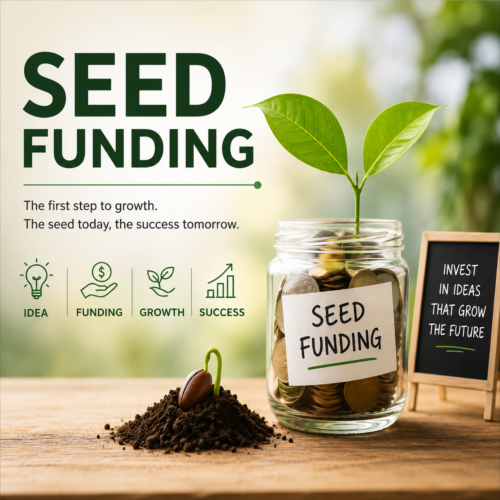
Every startup begins with an idea, but transforming that idea into a successful business requires financial support. Most startups do not start earning revenue immediately and need funds to develop products, hire employees, conduct market research, and attract customers. This initial financial support is known as seed funding. It is the first investment received by a startup to help it move from the idea stage to the execution stage. In simple terms, seed funding acts as the foundation of a startup. Just as a seed needs water and sunlight to grow into a tree, a startup needs capital to develop into a sustainable business.
SEED FUNDING HELPS STARTUPS:
- Develop a prototype or MVP
- Conduct market research
- Test their product or service
- Hire initial team members
- Build brand awareness
- Cover operational expenses
WHY IS SEED FUNDING IMPORTANT?
Many innovative business ideas fail not because they lack potential, but because they lack financial resources. Seed funding allows entrepreneurs to focus on building and validating their business rather than worrying about immediate financial constraints. With adequate funding, startups can accelerate product development, reach customers faster, and create a strong foundation for future growth.
BENEFITS OF SEED FUNDING:
- Enables faster product development
- Supports business validation
- Helps attract customers and investors
- Provides financial stability in the early stage
- Increases startup credibility
WHO CAN GET SEED FUNDING?
- DPIIT-recognized startups
- Early-stage startups
- Entrepreneurs with innovative business ideas
- Startups with a prototype or MVP
- Businesses with high growth potential
- Startups incubated at recognized incubators
- Student entrepreneurs and first-time founders
- Technology-driven and scalable startups
- Research and innovation-based ventures
- Startups solving real market problems 🚀
HOW DOES SEED FUNDING WORK?
The seed funding process begins when a startup identifies a market problem and develops an innovative solution. To secure funding, the founders prepare a detailed business plan and pitch deck explaining their product or service, target market, revenue model, growth strategy, and future potential. They then approach investors, incubators, accelerators, or government funding schemes to present their idea. The funding organization evaluates various factors such as the uniqueness of the solution, market demand, business viability, scalability, and the capabilities of the founding team. If the startup demonstrates strong growth potential and a sustainable business model, it may receive financial support in the form of a grant, loan, or equity investment. The funds are then used to develop the product, conduct market testing, hire key personnel, and expand business operations.
SOURCES OF SEED FUNDING IN INDIA
Common sources of seed funding:
- Government startup schemes
- Angel investors
- Startup incubators
- Accelerators
- Venture capital funds
- Friends and family
WHAT CAN SEED FUNDING BE USED FOR?
Seed funding is intended to help startups establish themselves and prepare for growth. It should be used strategically to achieve business milestones and validate the startup’s business model.
Common uses of seed funding:
- Product development
- Research and development
- Prototype creation
- Technology infrastructure
- Marketing and promotion
- Hiring employees
- Business registration and compliance
- Customer acquisition
TYPES OF SEED FUNDING
Seed funding can be structured in different ways depending on the funding source and startup requirements.
- Grant Funding- Financial assistance that generally does not require repayment or ownership dilution.
- Loan Funding- Funds provided with the obligation to repay according to agreed terms.
- Equity Funding- Investors provide capital in exchange for ownership in the startup.
- Convertible Instruments- Funding that may convert into equity at a later stage based on specific conditions.
CHALLENGES IN SECURING SEED FUNDING
Although funding opportunities have increased in India, obtaining seed funding remains competitive. Investors and funding agencies carefully evaluate startups before investing.
Common challenges:
- Lack of a clear business model
- Weak market research
- Poor pitch presentation
- Limited customer traction
- Unrealistic financial projections
- Inexperienced founding team
HOW TO IMPROVE YOUR CHANCES OF GETTING SEED FUNDING
Securing seed funding requires more than a good idea. Investors want evidence that the startup can solve a real problem and grow into a sustainable business.
Tips for founders:
- Solve a genuine market problem
- Build a working prototype
- Validate demand with customers
- Prepare a compelling pitch deck
- Develop realistic financial projections
- Build a strong founding team
- Clearly define the revenue model
CONCLUSION
Seed funding is the first financial boost that helps startups transform innovative ideas into real businesses. It enables entrepreneurs to develop products, validate markets, hire teams, and establish operations during the crucial early stages of growth. Whether the funding comes from government schemes, angel investors, incubators, or venture capital firms, its primary purpose remains the same—to help startups build a strong foundation for future success. CorpBuddy supports startups throughout this journey by assisting with startup registration, compliance, documentation, funding applications, and investor readiness, helping entrepreneurs access growth opportunities and turn their ideas into successful ventures.
KEY TAKEAWAYS
- Seed funding is the first investment received by a startup.
- It helps convert an idea into a market-ready business.
- Funding can come from government schemes, investors, incubators, or venture capital firms.
- Seed funding may be provided as grants, loans, equity, or convertible instruments.
- Proper planning, market validation, and a strong business model improve funding opportunities.
- A great idea may start a startup, but seed funding provides the resources needed to turn that idea into a successful business.
WRITTEN BY – IPSHITA GHOSH 3RD YEAR (BA LLB)
By entering the email address you agree to our Privacy Policy.