MCA COMPLIANCE CALENDAR 2026–27: IMPORTANT DUE DATES EVERY COMPANY SHOULD KNOW
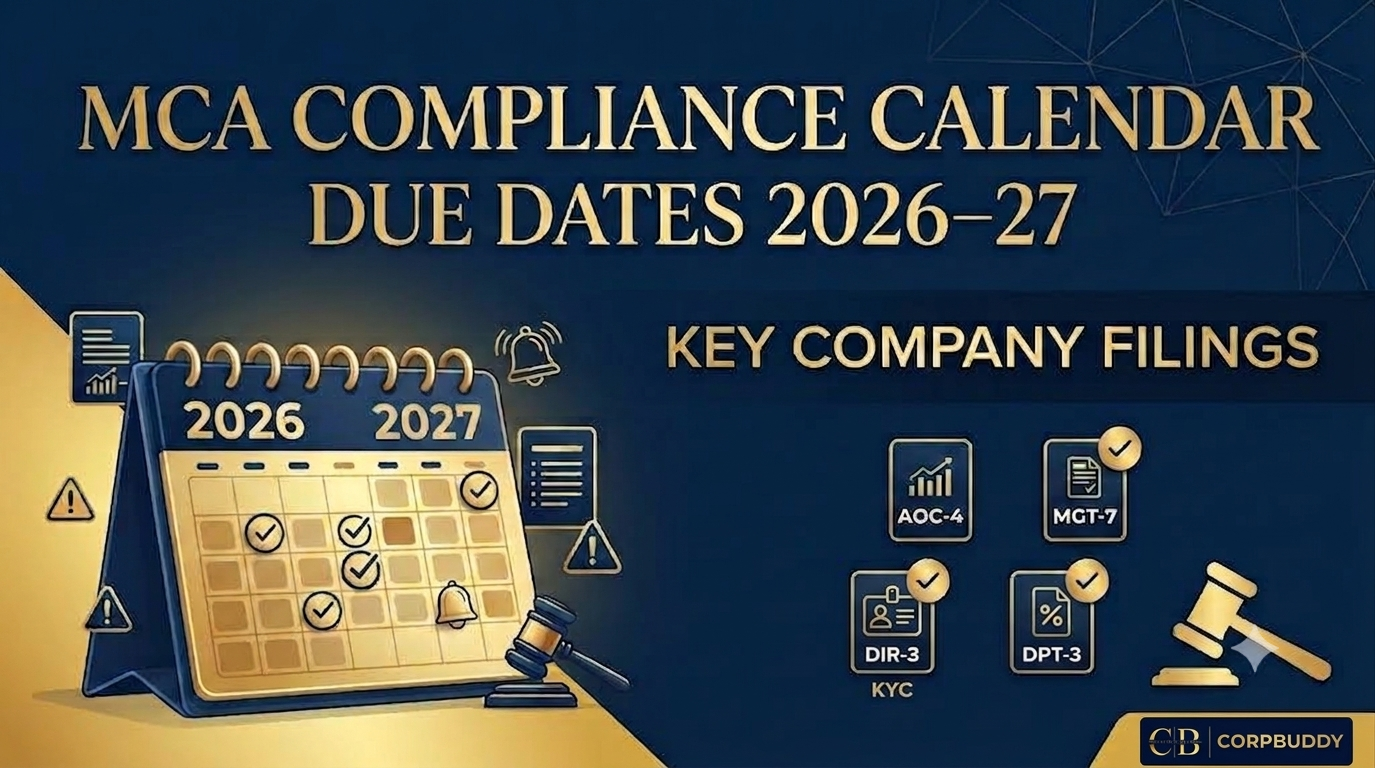
Starting and running a business is not just about sales, profits and growth. If you have a company in India, you also have certain legal compliances to complete every year. These compliances are filed with the Ministry of Corporate Affairs (MCA). Missing a deadline can lead to additional fees, penalties and unnecessary compliance problems. That is why having an MCA Compliance Calendar is important. In this blog, we have explained the major MCA compliances for FY 2026–27 in simple terms so that business owners can easily understand what needs to be filed and when.
What is an MCA Compliance Calendar ?
Simply put, an MCA Compliance Calendar is a list of all the important filings that a company needs to complete during the year. Think of it as a reminder calendar for your business’s legal compliances. The compliances that apply to your business depend on factors such as the type of entity, turnover, share capital, transactions and other applicable conditions.
Why Is MCA Compliance Important for Your Company?
1. Keeps Company Records Updated
MCA maintains the official records of companies. Every year, a company has to provide information about its financial statements, directors, shareholders and other required details. Example: A company files AOC-4 to submit its financial statements and MGT-7/MGT-7A to provide its annual company details.
2. Avoids Fees and Penalties
Every MCA form has a prescribed deadline. If a company files late, it may have to pay additional filing fees or face penalties, depending on the compliance. Example: If AOC-4 is due after the AGM and the company files it late, additional fees can apply.
3. Maintains the Company’s Active Status
A company must continue meeting its legal requirements after incorporation. Regular compliance shows that the company is properly operating and meeting its statutory obligations. Failure to comply with certain requirements for a prolonged period can result in regulatory action. Example: A company regularly files its annual forms and maintains its statutory records → it demonstrates that it is keeping up with its legal obligations.
4. Ensures Proper Corporate Governance
Corporate governance means running the company in a proper, transparent and accountable manner. MCA compliances ensure that important information about the company is properly recorded and reported.
MCA Post-Incorporation Compliances List
| Compliance | What is it? | Who Needs to File? | Due Date | Example |
| First Board Meeting (Sec. 173) | First meeting of the Board to discuss company operations and compliance requirements. | All Companies | Within 30 days of incorporation | Board discusses company operations and records compliance requirements. |
| Appointment of Auditor (Sec. 139) | Appointment of the company’s first auditor. | All Companies | Within 30 days of incorporation | Board appoints the first auditor within 30 days. |
| Intimation of Director Details (DIR-3 KYC) | Filing/verification of director details with MCA. | Applicable Directors/DIN Holders | Within 30 days of DIN allotment | Director updates PAN, mobile and email details. |
| Register of Members (Sec. 88) | Maintenance of the statutory register of members and other security holders. | All Companies | Maintain continuously | Company maintains details of members and debenture holders. |
| Register of Directors & KMP (Sec. 170) | Maintenance of details of directors and Key Managerial Personnel. | All Companies | Maintain continuously | Company maintains its register of directors and KMP. |
| Share Capital Compliance (Secs. 42, 86) | Compliance relating to issue, allotment and changes in share capital. | As applicable | As per requirements | Company issues additional shares and completes the required filings. |
| Annual Return (MGT-7) | Annual filing containing details of the company, shareholders, directors and share capital. | Applicable Companies | Within 60 days of AGM | Company files its annual return with the ROC. |
| Financial Statements (AOC-4) | Filing of financial statements with the Registrar of Companies. | Companies required to file financial statements | Within 30 days of AGM | AGM held on 30 September → AOC-4 generally filed by 30 October. |
| INC-20 | Declaration of commencement of business. | Companies to which Sec. 10A applies | Within 180 days of incorporation | Company files declaration confirming commencement of business. |
| DPT-3 | Reports deposits and certain other amounts received by the company. | Companies covered under DPT-3 requirements | 30 May | Company has a covered loan/amount outstanding → reports it to MCA. |
| MSME-1 | Reports certain outstanding dues to Micro & Small Enterprises. | Companies having applicable MSME dues | 30 April & 31 October | Company has applicable unpaid MSME supplier dues → files MSME-1. |
| AGM | Annual General Meeting of shareholders. | Generally all companies except OPCs | By 30 September | FY ends 31 March → AGM is generally held by 30 September. |
| MGT-7A | Simplified Annual Return. | OPCs & Small Companies | Within 60 days of AGM | Small Company → files MGT-7A. |
| DIR-3 KYC | KYC verification of DIN holders. | Applicable Directors/DIN Holders | As prescribed by MCA | Director updates PAN, mobile and email details. |
| PAS-6 | Share capital reconciliation statement. | Applicable Unlisted Public Companies | Within 60 days of each half-year | Company reconciles its share capital records. |
| BEN-2 | Filing relating to Significant Beneficial Ownership (SBO). | Companies where SBO reporting applies | Generally within 30 days of BEN-1 | Company receives BEN-1 → files BEN-2. |
| Other Statutory Registers | Maintenance of statutory registers required under the Companies Act, 2013. | All Companies, as applicable | Maintain continuously | Registers relating to charges, loans, investments, contracts, etc. |
| Event-Based Filings | Filings required when specific changes occur in the company. | As applicable | As per event-specific requirement | Change in directors → DIR-12; change in registered office → applicable ROC filing. |
What Happens If You Miss an MCA Deadline?
Missing an MCA deadline does not simply mean that the filing can be ignored. Depending on the form and the nature of the delay, the company or LLP may have to pay additional filing fees or penalties.
More importantly, repeated non-compliance can create problems when the business needs to:
- Maintain proper statutory records
- Make changes in the company
- Raise funds
- Deal with investors
- Apply for certain registrations or approvals
- Complete other corporate transactions
Therefore, it is always better to prepare the documents and filings before the due date.
How Can You Stay Compliant?
1. Prepare a yearly compliance calendar- List all forms applicable to your company or LLP along with their due dates.
2. Keep documents ready in advance- Financial statements, board reports, meeting records and other required documents should be prepared before the filing deadline.
3. Set reminders- Set reminders at least 15–30 days before every important due date.
4. Check applicability every year- Not every form applies to every business. Your compliance requirements may change as your business grows or your transactions change.
5. Review your compliance regularly-Instead of checking everything at the end of the year, review your compliance status periodically.
CONCLUSION
MCA compliance doesn’t have to be complicated. CorpBuddy, Raipur helps you manage your MCA and ROC filings, track deadlines and stay compliant on time. Focus on your business — let CorpBuddy handle your compliances. Get in touch with CorpBuddy, Raipur today!
WRITTEN BY IPSHITA GHOSH ( BA LLB ) (4th year )
By entering the email address you agree to our Privacy Policy.