CAN FORCE MAJEURE PROTECT YOUR CONTRACT FROM SUPERIOR FORCES?
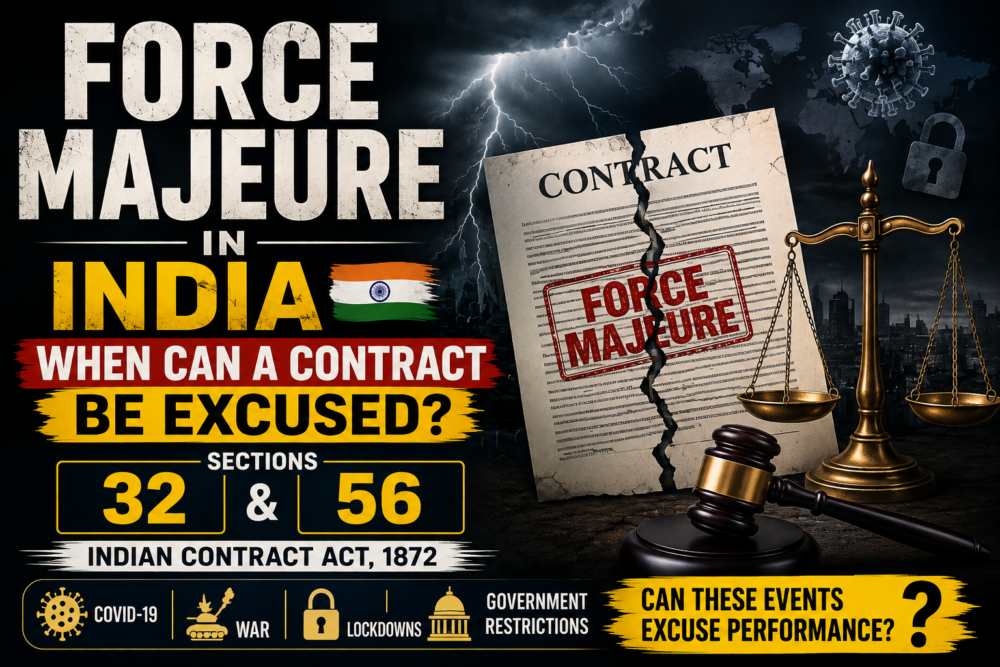
Contracts are built on a simple promise: if parties agree to perform, they must perform. But imagine a restaurant agreeing to supply meals for a large event when a sudden government lockdown prevents the event from taking place, or a construction company being unable to obtain materials because a cyclone has shut down transport routes. These unexpected problems may come under Force Majeure. It means an unusual event beyond a party’s reasonable control that stops, delays or seriously affects the performance of a contract. However, such an event does not automatically end the party’s contractual duties. The contract, the event and its actual effect on performance must be carefully examined.
WHAT IS FORCE MAJEURE?
Force Majeure means an extraordinary event beyond the parties’ reasonable control that prevents or delays contractual performance. It means “superior force.”
Common examples include:
- Natural disasters;
- Fire or explosions;
- War, terrorism or riots;
- Epidemics and pandemics;
- Government orders or lockdowns;
- Strikes and lockouts;
- Import or export restrictions; and
- Major transport or communication disruptions.
An event qualifies as Force Majeure only if it is covered by the contract and actually affects performance. For example, a lockdown may excuse delayed delivery if it directly prevents performance and no reasonable alternative exists. However, increased costs, reduced profits or commercial difficulty generally do not amount to Force Majeure if performance remains possible.
The claiming party must usually show that:
- The event was covered by the contract;
- It was beyond its control;
- It caused the delay or non-performance;
- No reasonable alternative was available; and
- Notice and mitigation requirements were followed.
Depending on the clause, the consequences may include extra time, suspension, protection from damages, renegotiation or termination. Thus, Force Majeure is not an automatic exemption from contractual liability.
WHAT IS THE LEGAL POSITION OF FORCE MAJEURE UNDER THE INDIAN CONTRACT ACT, 1872?
The Indian Contract Act, 1872 does not have a separate chapter specifically dealing with Force Majeure. Instead, Force Majeure-related disputes are generally considered under Sections 32 and 56, depending on the terms of the contract and the circumstances of the case.
In simple terms:
- Section 32 applies when the contract itself provides for a particular event and its consequences.
- Section 56 deals with situations where a contract becomes impossible or unlawful to perform because of an event occurring after the contract was made.
Section 32 of of the Indian Contract Act, 1872 – Contingent Contracts
Section 32 deals with contingent contracts. These are contracts where performance depends on whether a particular event happens or does not happen. A Force Majeure clause can work in this way when the parties agree in advance that certain unexpected events will affect their contractual duties. For example, suppose A agrees to supply goods to B. Before A can deliver the goods, a severe flood destroys the warehouse and roads connecting A to B. If the contract includes natural calamities such as floods as Force Majeure events, A may be protected from liability for the delay, depending on the exact wording of the contract and whether A took reasonable steps to resume performance.
In Energy Watchdog v. Central Electricity Regulatory Commission, the Supreme Court explained that when a Force Majeure clause is included in a contract, its effect mainly depends on the terms agreed upon by the parties. Therefore, the first question a court generally asks is: What exactly did the parties agree in their Force Majeure clause?
Section 56 of the Indian Contract Act, 1872- Doctrine of Frustration
Section 56 of the Indian Contract Act, 1872 deals with supervening impossibility or illegality. It applies when, after a contract has been made, an unexpected event makes the performance of the contract impossible or unlawful. This principle is known as the doctrine of frustration. Example A agrees to perform at a theatre for six months. Before the performance begins, the theatre is destroyed by fire. Since the performance has become impossible due to an event beyond the parties’ control, the contract may be treated as frustrated under Section 56. Similarly, if a new law prohibits the performance of a particular contract, the parties may no longer be legally permitted to perform it. In such a situation, the contract may become void from the time performance becomes impossible or unlawful.
In Nirmala Anand v. Adventz Investments and Holdings Ltd., the Supreme Court held that Section 56 applies only when an unforeseen event makes performance impossible, unlawful or fundamentally different. Mere difficulty, inconvenience, increased expense or changed circumstances is insufficient. Courts examine the contract, surrounding circumstances and actual impact on its essential purpose.
WHAT IS THE DIFFERENCE BETWEEN FORCE MAJEURE AND FRUSTRATION?
| Force Majeure | Frustration |
| Usually comes from a term written in the contract | Arises under Section 56 of the Contract Act. |
| Depends on what the parties agreed in the contract. | Depends on whether the legal conditions of frustration are met. |
| The contract decides which events are covered. | The court decides whether the contract has become frustrated. |
| It may pause, delay or change the contractual duties, depending on the clause. | It generally ends the contractual obligations when frustration is established. |
WHAT ARE THE LEADING CASE LAWS ON FORCE MAJEURE AND FRUSTRATION?
Satyabrata Ghose v. Mugneeram Bangur & Co. & Anr. (AIR 1954 SC 44)
Satyabrata Ghose v. Mugneeram Bangur & Co. is a leading Supreme Court decision on frustration under Section 56 of the Indian Contract Act, 1872.
Facts: Mugneeram Bangur & Co. agreed to develop a housing scheme on certain land and entered into an agreement with Satyabrata Ghose. During performance, the Government requisitioned a substantial portion of the land for military purposes. The requisition caused delay in the development project, and the company argued that the agreement had become impossible to perform and was therefore frustrated.
Issue: The main issue before the Court was whether temporary requisition of the land and the resulting delay made performance of the contract impossible under Section 56, thereby discharging the parties from their obligations.
Judgment: The Supreme Court rejected the company’s argument and held that the contract was not frustrated. The requisition was temporary, and performance could continue after the land was released. The Court explained that “impossible” under Section 56 does not mean only physical or literal impossibility; it may include practical or legal impossibility. However, frustration occurs only when a supervening event fundamentally changes the nature or purpose of the contract. Mere delay, increased expense, reduced profit, inconvenience, or difficulty in performance is insufficient. The Court emphasized that frustration must be determined from the terms of the contract, the surrounding circumstances, and the parties’ original intention.
ENERGY WATCHDOG V. CENTRAL ELECTRICITY REGULATORY COMMISSION & ORS. (2017) 14 SCC 80
Facts– In Energy Watchdog v. Central Electricity Regulatory Commission, (2017) 14 SCC 80, power-generating companies entered into Power Purchase Agreements to supply electricity at agreed tariffs. Subsequently, the price of Indonesian coal increased significantly because of changes in Indonesian regulations. The companies argued that the increased coal prices made performance more expensive and sought relief under the Force Majeure clauses or the doctrine of frustration.
Issues– The Supreme Court considered whether the rise in coal prices was covered by Force Majeure, whether it made performance impossible, and whether increased cost alone could excuse contractual performance.
Judgement– The Supreme Court held that when a contract contains a Force Majeure clause, the court must first examine the language of the contract and determine whether the event falls within the clause. The Court also held that a mere increase in cost or expense is generally not enough to frustrate a contract. A party cannot simply claim: “The contract has become expensive, so I do not have to perform it.”The Court found that the increase in coal prices did not make performance impossible or fundamentally different from what the parties had agreed. Therefore, the companies could not rely on Force Majeure or frustration to avoid their contractual obligations. The case establishes that the actual requirements of the contractual clause must be satisfied, and commercial hardship alone does not discharge a party from performance.
WHAT IS THE DIFFERENCE BETWEEN IMPOSSIBILITY, DIFFICULTY AND INCREASED COST?
It is important to understand the difference between these three situations. Impossibility means that the contract cannot be performed legally or practically. For example, a government order may completely stop the activity required by the contract. Difficulty means that the contract can still be performed, but it has become harder. For example, transportation may become difficult because of restrictions, but another legal way of transporting the goods may still be available. Increased cost means that the contract can still be performed, but it has become much more expensive. For example, the price of raw materials may suddenly increase. Difficulty and increased cost do not automatically amount to Force Majeure or frustration. The simple rule is that a contract becoming less profitable is not the same as a contract becoming impossible to perform.
CONCLUSION
Force Majeure is a legal safeguard, not an escape from contractual responsibility. It applies only when extraordinary events beyond reasonable control prevent or fundamentally alter promised performance. Under Indian law, it is primarily governed by the parties’ agreement under Section 32 of the Indian Contract Act. Section 56 applies when a supervening event makes performance impossible or unlawful. Courts generally enforce contracts unless the agreement or law provides otherwise. Satyabrata Ghose and Energy Watchdog confirm that hardship, delay, increased expense, market volatility, or commercial inconvenience—even severe—does not automatically frustrate a contract. Relief requires satisfying the Force Majeure clause or strict frustration requirements.
REFERENCES
- https://www.casemine.com/judgement/in/58ed051f53bee77d50c41d9f
- https://www.mylawman.co.in/2022/10/case-brief-energy-watchdog-v-central.html
- https://supremecourtindia.in/judgments/supreme-court/1953/satyabrata-ghose-vs-mugneeram-bangur-and-co-and-another-1953-11-16/
- Indian Contract Act, 1872, §§ 32, 56.
By entering the email address you agree to our Privacy Policy.