
GUMASTA VS TRADE LICENSE IN RAIPUR: KEY DIFFERENCES, RULES & REQUIREMENTS
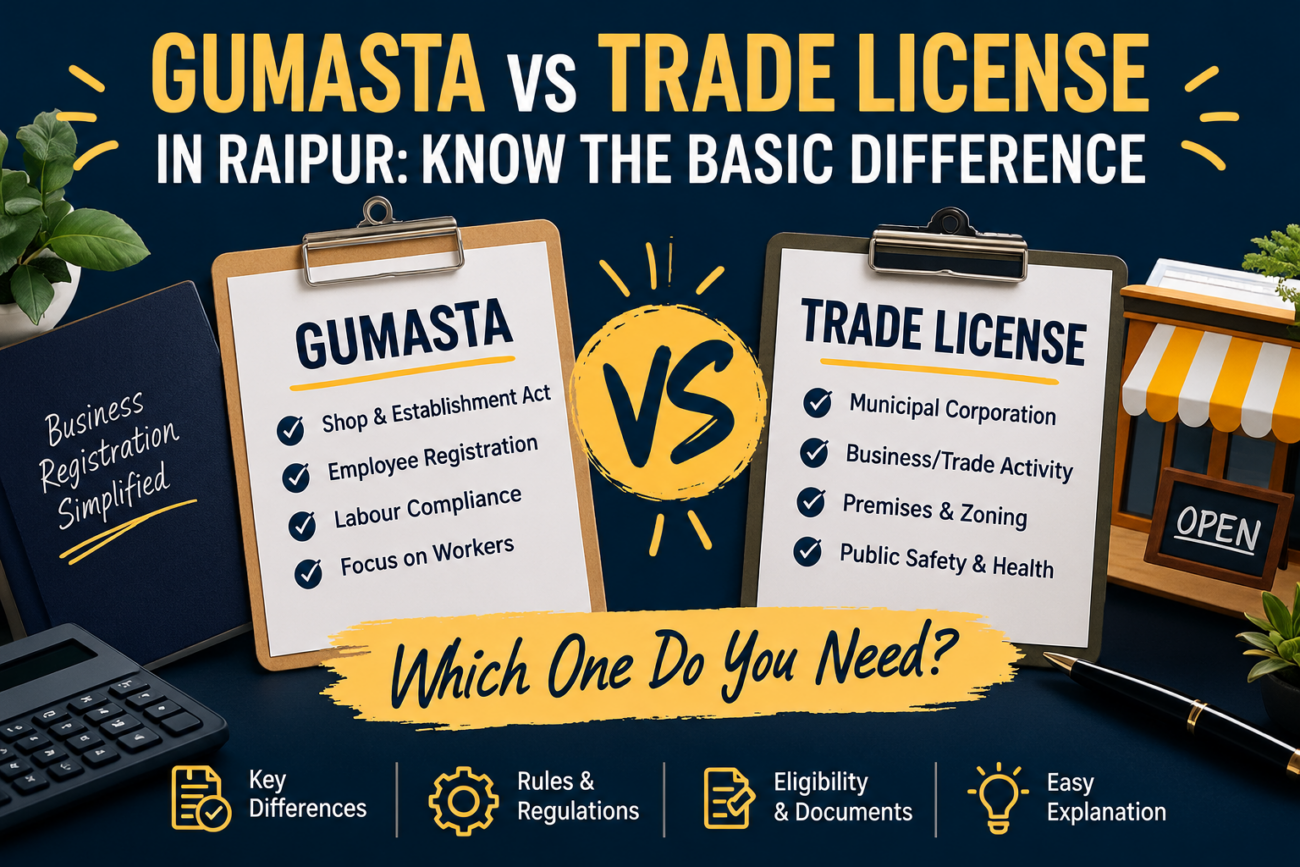
Starting a business in Raipur is exciting—but understanding the paperwork can be confusing. One of the most common questions new business owners ask is: “Do I need a Gumasta or a Trade License? Aren’t they the same thing?” The confusion is understandable because both are connected with running a business, and the terms are often used interchangeably. However, Gumasta and Trade License generally serve different purposes and are associated with different regulatory requirements. Whether you are opening a shop, office, restaurant, salon, or service business in Raipur, knowing the basic difference can help you understand which compliance may apply to your business. Let us understand the difference clearly.
What is a Gumasta?
“Gumasta” is a commonly used term for Shop and Establishment registration. It is mainly connected with the registration of a shop, office, commercial establishment, or other covered establishment. Its focus is generally on the business establishment and employment-related compliance. For example, a clothing shop, office, or service establishment may fall under Shop and Establishment requirements, depending on the applicable rules.
What is a Trade License?
A Trade License is a permission issued by the relevant municipal authority for carrying on certain types of trade or business activities. Its main purpose is to regulate applicable business activities from a local and municipal perspective. For example, certain restaurants, commercial establishments, and other businesses may require a Trade License depending on the nature of their activities and local requirements.
Gumasta vs Trade License: Key Differences
| Basis | Gumasta | Trade License |
| 1. Purpose | Mainly relates to the registration of a shop or establishment. | Generally provides permission to carry on certain business or trade activities. |
| 2. Main Focus | Focuses mainly on the establishment and employment-related compliance. | Focuses mainly on the business activity and municipal requirements. |
| 3. Issuing Authority | Generally associated with the Labour Department. | Generally issued by the Municipal Corporation or municipal authority. |
| 4. Nature of Document | It is generally a registration of the shop or establishment. | It is a licence or permission for an applicable trade or business activity. |
| 5. Applicability | Applies to shops and establishments covered by applicable Shop and Establishment requirements. | Applies to businesses or activities for which municipal rules require a licence. |
| 6. Regulatory Focus | Mainly deals with the establishment and labour-related aspects of business operations. | Mainly deals with the local and municipal regulation of business activities. |
| 7. Can One Replace the Other? | Gumasta does not automatically replace a Trade License where a separate Trade License is required. | A Trade License does not automatically replace applicable Shop and Establishment registration. |
| 8. Easy Way to Remember | Gumasta = Shop/Establishment Registration | Trade License = Business/Trade Activity Licence |
Practical Example:
Imagine Rahul opens a restaurant in Raipur. He needs to understand the different registrations and licences required to legally operate his business. Gumasta and Trade License serve different purposes, which can be understood through Rahul’s example.
| Gumasta / Shop & Establishment | Trade License |
| Rahul may need to complete the applicable Shop and Establishment registration for his restaurant. | Rahul may also need a Trade License if his restaurant activity falls under the municipal licensing requirements. |
| The main concern is the restaurant as an establishment and applicable employment-related compliance. | The main concern is the restaurant’s business activity under municipal regulations. |
| It is generally associated with the Labour Department. | It is generally handled by the Municipal Corporation/municipal authority. |
| It is a registration. | It is a licence/permission. |
Gumasta asks: “Is my shop or establishment registered under the applicable requirements?”
Trade License asks: “Is my particular business activity licensed under the applicable municipal requirements?”
Therefore, Gumasta and Trade License should not be treated as automatically interchangeable. The actual requirements depend on the nature of the business and the rules applicable to it.
Why Does the Difference Matter?
A business owner should not assume that obtaining one automatically fulfils the requirements of the other. For example, a business may have to deal with Shop and Establishment requirements because of the nature of its establishment, while a Trade License may be required because of the particular business activity and municipal rules. Apart from these, a business may also need other registrations or approvals such as GST registration, FSSAI registration, fire-related approvals, or sector-specific licences, depending on the nature of the business. Therefore, identifying the correct requirement at the beginning can help avoid unnecessary delays and compliance problems.
Simple Example
Imagine that you are opening a clothing shop in Raipur. The shop may have to comply with applicable Shop and Establishment requirements, commonly referred to as Gumasta registration. If the particular activity also requires a municipal Trade License, that would be a separate requirement. Similarly, a restaurant may have additional licences and approvals because of the nature of its business. This shows why the terms Gumasta and Trade License should not automatically be treated as the same document.
What Documents May Be Required?
The exact documents can vary depending on the registration or licence and the type of business. Commonly requested documents may include:
- Identity and address proof of the applicant
- PAN details
- Business address or premises proof
- Rent agreement or ownership documents, where applicable
- Details of the business and its nature of activity
- Partnership deed or company/LLP documents, where applicable
- Other licences or NOCs, if applicable
Note- It is always advisable to check the current requirements before submitting an application.
How Does the Application Process Generally Work?
The basic process usually involves:
1. Identify the requirement- Determine whether your business needs Shop and Establishment registration, Trade License, or both.
2. Prepare the documents– Keep identity, address, business, and premises-related documents ready.
3. Apply to the appropriate authority– Shop and Establishment matters and municipal Trade License matters are handled through their respective authorities and systems.
4. Pay the applicable fee– The fee depends on the type of registration or licence and applicable rules.
5. Complete verification– The authority may review the application and documents.
6. Receive the registration/licence– Once approved, the relevant registration or licence is issued.
Common Mistakes Business Owners Should Avoid
1. Treating Gumasta and Trade License as the Same- They generally serve different purposes. Always check what the particular document actually covers.
2. Assuming One Licence Covers Everything– A Trade License or Shop and Establishment registration does not automatically replace other applicable business compliances.
3. Using Outdated Information– Business registration requirements can change. Always check the latest requirements before applying.
4. Choosing the Wrong Business Category– The nature of your business can affect the licences and approvals required. Providing incorrect business details can create compliance issues.
Frequently Asked Questions
- Is Gumasta the same as a Trade License?
No. Gumasta is commonly used to refer to Shop and Establishment registration, while a Trade License generally
relates to permission for certain business or trade activities under municipal regulations.
- Do I need both Gumasta and Trade License?
It depends on your business activity, establishment, premises, and applicable requirements. Some businesses may
require one, while others may need both along with additional approvals.
- Who issues a Trade License in Raipur?
A Trade License is generally dealt with by the relevant municipal authority for the area in which the business operates.
- Can a Trade License replace GST registration?
No. A Trade License and GST registration serve different purposes. GST registration is a tax-related compliance, while a
Trade License relates to applicable municipal requirements.
- Can Gumasta replace a Trade License?
No. Shop and Establishment registration and Trade License generally address different regulatory requirements.
Conclusion
Gumasta and Trade License may sound similar, but they are not automatically the same thing. Understanding which authority deals with each requirement and what each document is meant to cover can make business registration much easier. Need to get your Trade License in Raipur? Let CorpBuddy, Raipur make the process simple and hassle-free. Our team assists you with the required documentation and application process, helping you complete your Trade License registration smoothly. Get your Trade License done with CorpBuddy, Raipur today!
WRITTEN BY IPSHITA GHOSH, 4TH YEAR (B.A.LL.B)
By entering the email address you agree to our Privacy Policy.