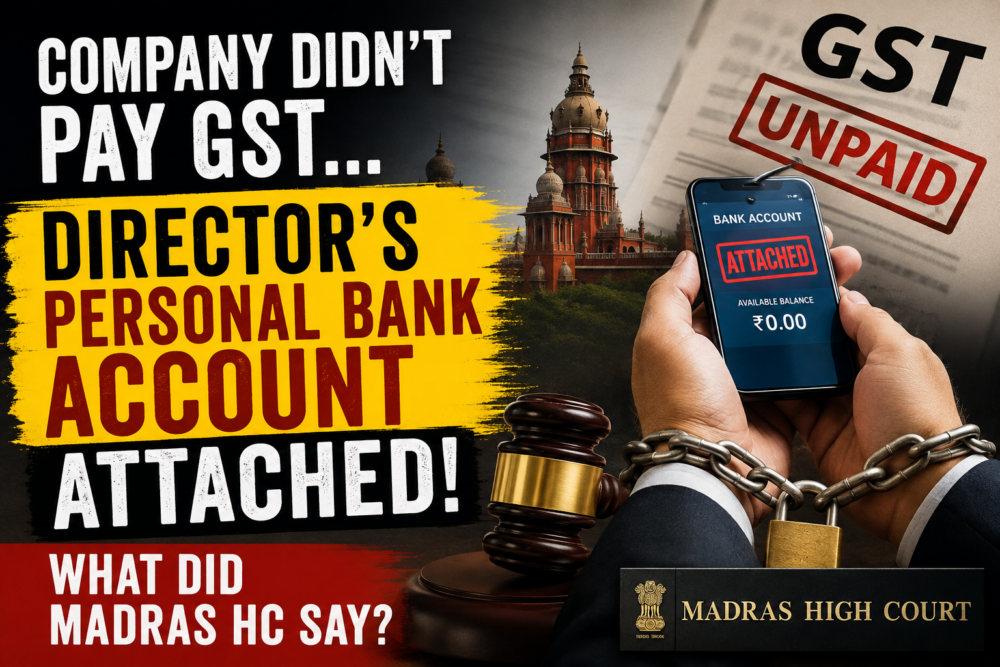
COMPANY DIDN’T PAY GST… DIRECTOR’S PERSONAL BANK ACCOUNT ATTACHED! WHAT DID MADRAS HC SAY?
| Case Name | Khalid Buhari v. Assistant Commissioner of CGST & Central Excise & Another |
| Petitioner | Khalid Buhari |
| Respondents | Assistant Commissioner of CGST & Central Excise & Another |
| Court | Madras High Court |
| Case No. | W.P. No. 50484 of 2025 |
| Date of Judgment | 13 February 2026 |
| Judge | Hon’ble Mr. Justice C. Saravanan |
INTRODUCTION
The Madras High Court in Khalid Buhari v. Assistant Commissioner of CGST and C.Ex. dealt with an important issue concerning the extent to which GST authorities can proceed against company directors for recovery of tax dues. The case arose when the Department attempted to recover a company’s unpaid GST by attaching the personal bank account of one of its directors, treating the liability as if it were personal in nature. This raised a significant question on the scope of director liability under the CGST Act.|
FACTS OF THE CASE
- The petitioner, Khalid Buhari, was a director of M/s Trans Car India Private Limited.
- The company received a GST demand order dated 31 May 2023, meaning the tax department said the company had to pay certain GST dues.
- Instead of directly following the normal appeal process, the company first approached the Madras High Court, but the case was dismissed on 22 September 2023, with a direction to file an appeal before the proper Appellate Authority.
- However, the company did not file that appeal. Instead, it filed a writ appeal, which was also dismissed on 19 December 2023.
- Since the tax was still unpaid, the GST Department began recovery proceedings.
- On 25 November 2025, the Department issued Form GST DRC-13 and attached the personal bank account of the director to recover the company’s GST dues.
- The director then challenged this action before the Madras High Court.
MEANING OF GST DRC-13
GST DRC-13 is a recovery notice used by the GST Department to recover unpaid tax from a third party. In simple terms, if a taxpayer such as a company does not pay its GST dues, the Department can direct another person who owes money to that taxpayer, such as a bank holding the taxpayer’s account, to pay the government directly instead. In this case, the Department used DRC-13 to freeze or attach the director’s bank account, treating it as a recovery step for the company’s unpaid GST.
Example: Suppose a company, XYZ Pvt. Ltd., has unpaid GST of ₹5 lakh. The company does not pay even after repeated notices. The GST Department then issues a DRC-13 notice to XYZ’s bank, where the company has a savings account. The bank is directed to freeze the account and transfer the available balance up to ₹5 lakh directly to the government. In the present case, instead of the company’s account, the Department wrongly proceeded against the director’s personal bank account using DRC-13, treating it as a recovery measure for the company’s tax dues.
ISSUES BEFORE THE COURT
- Can the GST Department recover a private company’s GST dues from the director’s personal bank account under Section 89 of the CGST Act?
- Can the director be held personally liable without first giving him an opportunity to prove that the non-payment was not due to his gross neglect, misfeasance or breach of duty?
ARGUMENTS OF PETITIONER
- The GST dues were of the company, not his personal liability.
- He argued that he could not be made personally liable only because he was a director.
- Section 89 of the CGST Act applies only when its specific conditions are fulfilled.
- He should have been given an opportunity to prove that the non-payment was not due to his gross neglect, misfeasance or breach of duty.
- The Department directly proceeded against his personal bank account through DRC-13.
- He argued that such recovery from his personal account was not justified without first determining his personal liability.
- He therefore requested the Court to quash the recovery action against him.
ARGUMENTS OF RESPODENT
- The company had outstanding GST dues which remained unpaid.
- The Department had already initiated recovery proceedings against the company.
- The petitioner was a director of the private company.
- The Department relied upon Section 89, which provides for personal liability of directors in certain circumstances.
- Since the company’s dues remained unrecovered, the Department argued that recovery could be pursued against the director subject to the provisions of law.
- The Department therefore defended the recovery proceedings initiated against the petitioner.
WHAT IS SECTION 89 CGST ACT ?
Section 89(1) of the CGST Act provides that company directors can be held personally liable for unpaid GST only in specific situations. If a private company fails to pay GST, interest, or penalty and the government cannot recover the dues from the company, the authorities may proceed against the directors in charge during that period. In such cases, directors may be asked to pay from their personal assets. However, this liability is not automatic. A director is not personally liable if he proves that the default was not due to his fault.To avoid liability, the director must show there was no gross neglect, misfeasance, or breach of duty on his part.
Example– If XYZ Pvt. Ltd. has ₹10 lakh GST dues and the Department cannot recover it from the company, it may proceed against the directors under Section 89. But if a director, Mr. A, proves he was not involved in financial decisions and had objected to non-payment of taxes, he can show there was no fault on his part. In that case, if the Department accepts his explanation, he will not be personally liable, and recovery will not be made from his personal assets.
FINDING OF THE MADRAS HIGH COURT
- The Court carefully examined Section 89 of the CGST Act and explained the legal position regarding when a director of a company can be made personally liable for the company’s unpaid tax dues.
- The Court observed that the provision does not create automatic liability on directors. Instead, it places a clear burden on the director to demonstrate that the non-payment of tax by the company was not due to his own conduct. In other words, the director must show that the default in payment of GST did not arise because of his gross neglect, misfeasance, or breach of duty in relation to the affairs of the company.
- This requirement is important because personal liability under Section 89 is not meant to be imposed mechanically. It is a conditional liability, and those conditions must be strictly satisfied before any recovery can be initiated against a director personally.
- The Court further emphasized that principles of natural justice must be followed. This means that before the Department proceeds to recover the company’s tax dues from a director, the director must be given a fair and reasonable opportunity to present his explanation and defend himself. He must be allowed to place on record facts and evidence showing that he was not responsible for the company’s failure to pay the tax.
- In the present case, the Court found that this essential opportunity was not provided to the director. The GST Department had proceeded directly with recovery action without properly considering his defence or giving him a meaningful chance to explain his position.
- Because of this procedural lapse, the Court held that the action of the Department could not be sustained in law. As a result, the Court set aside (cancelled) the recovery notice issued against the director.
- However, the Court did not close the matter entirely. Instead, it remanded the case back to the GST Department with a direction to reconsider the issue afresh. The Department was instructed to follow due process, give the director a proper hearing, examine his explanation in light of Section 89, and then pass a reasoned and lawful order.
DECISION OF THE COURT
The Madras High Court:
- Cancelled the GST DRC-13 recovery notice dated 25 November 2025;
- Sent the matter back to the GST authority for reconsideration;
- Allowed the director to file a proper reply explaining why recovery should not be made from him personally;
- Directed the authority to pass a fresh order after considering the reply;
- Directed that proper notice must be given before passing any adverse order.
- The Court also clarified that if the petitioner does not comply with the directions, the Department is free to proceed as per law.
IMPORTANT CLARIFICATION
- The judgment should not be interpreted to mean that directors are completely protected from a company’s GST liabilities.
- Section 89 of the CGST Act expressly provides a mechanism for fixing personal liability on directors in appropriate cases.
- However, the GST Department cannot bypass the statutory procedure and directly proceed against a director merely because of his designation.
- Recovery action must not be mechanical or automatic.
- The Department must examine the specific facts of the case, including the company’s ability to recover dues.
- The conduct of the director in relation to the company’s affairs must also be assessed.
- Only after considering these factors can personal liability under Section 89 be properly determined.
WHY THIS JUDGMENT IS IMPORTANT
- This ruling is particularly significant for directors of private limited companies, as GST authorities may, in appropriate circumstances, attempt recovery from directors when the company’s dues remain unrecovered.
- It reinforces an important procedural safeguard under the GST law.
- The recovery process follows a structured sequence:
- Company’s GST liability arises
- Recovery is first initiated against the company
- If dues remain unrecovered, Section 89 may be invoked against relevant directors
- The director must be given an opportunity to establish the statutory defence
- Directors should therefore not ignore GST recovery notices issued in their individual capacity, as they may have legal consequences if not properly responded to.
CONCLUSION
The Khalid Buhari judgment strikes a vital balance between the GST Department’s recovery powers and statutory safeguards for directors. It clarifies that personal liability under Section 89 is not automatic and must follow due process. Directors must actively present their defence, ensuring accountability without undermining legal protection framework of law.
REFERENCES
- https://taxo.online/latest-news/25-02-2026-personal-recovery-from-a-director-under-section-89-arises-only-when-tax-dues-cannot-be-recovered-from-the-private-company-madras-high-court/
- https://gstpress.com/caselaw/cmm5s2eld000gkecly6dg6z56/director-must-prove-no-gross-neglect-to-avoid-company-s-unrecovered-tax-liability-under-section-89?from_page=6
WRITTEN BY IPSHITA GHOSH, 4TH YEAR (B.A.LL.B)
By entering the email address you agree to our Privacy Policy.