BUSINESS CLOSED BUT COMPANY IS STILL ACTIVE: LEGAL CONSEQUENCES EVERY BUSINESS OWNER SHOULD KNOW
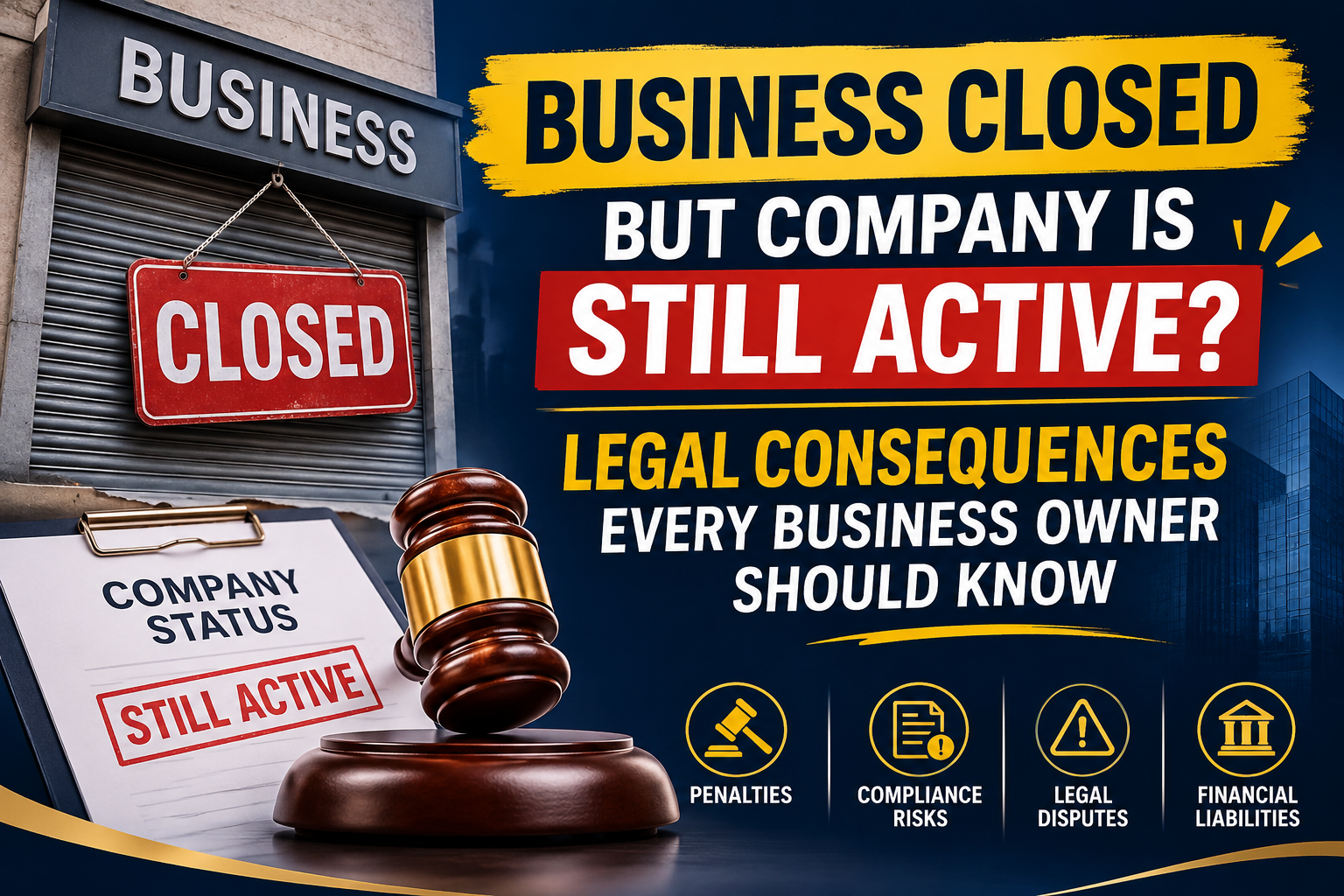
Imagine closing your business, shutting down your office, and stopping all sales. You think everything is over, right? Not so fast! Your company may still be legally active with the MCA. And that means compliance duties, penalties and legal risks may continue. Closed business, but active company? Here’s what every business owner must know!
What Does It Mean When a Business Is Closed but the Company Is Active?
First, understand the difference between a business and a company.
- Business closed: You have stopped your business activities, such as selling products, providing services, or dealing with customers.
- Company active: Your company is still legally registered with the government and its name remains on the MCA records.
For example, suppose Rahul starts ABC Private Limited to run a clothing business. After two years, he faces losses and closes his clothing store. However, he does not apply for the company’s legal closure, does not complete the required filings, and does not take any steps to close the company. Even though Rahul has stopped selling clothes, ABC Private Limited continues to exist as a legal entity. This means that the company may still have to follow applicable legal and financial requirements.
Why Is It Dangerous to Leave a Company Active After Closing the Business?
Here are some important legal consequences every business owner should understand.
- Annual ROC Filing Does Not Automatically Stop
One of the biggest mistakes business owners make is assuming that if the company has stopped earning money, it no longer needs to file documents. This is incorrect. Under the Companies Act, 2013, companies generally have to file their annual returns and financial statements with the Registrar of Companies (ROC), even if they have not carried out business activities.
Important filings include:
- AOC-4: Filing of financial statements.
- MGT-7 / MGT-7A: Filing of the company’s annual return, as applicable.
Even if your company has zero sales or no business transactions, applicable filing requirements may continue.
Example: Priya closes her event management company in 2025. She believes that because there is no income, she does not need to file anything with the ROC. Two years later, she discovers that her company has accumulated pending compliance requirements and additional filing costs.
- Directors May Face Disqualification
Did you know that the directors of a company can also face consequences if the company repeatedly fails to comply with filing requirements? Under Section 164(2) of the Companies Act, 2013, a director may become disqualified if the company has not filed financial statements or annual returns for a continuous period of three financial years. This can affect the director’s ability to continue as a director or be appointed in another company, subject to the applicable legal provisions.
Example: Amit and Rahul are directors of XYZ Private Limited. They close their business but forget to complete the company’s annual filings for three consecutive financial years. They may face director-disqualification consequences under the law.
- Penalties and Additional Filing Fees May Increase
A company does not become free from its legal responsibilities simply because it has stopped operating. Failure to submit required documents within the prescribed time can result in additional fees and applicable penalties.
For example:
- Delayed annual returns can attract additional filing fees.
- Delayed financial statements can attract additional filing fees.
- Certain non-compliances can result in penalties against the company and officers in default.
- Outstanding Loans and Liabilities Do Not Disappear
This is another major issue. Suppose your company has stopped operating, but it still has:
- Outstanding bank loans.
- Unpaid vendor bills.
- Employee salary dues.
- Pending rent payments.
- Tax liabilities.
- Payments owed to customers.
- Can you simply close the company and forget these payments?
No. Closing business operations does not automatically cancel existing financial obligations. The company must address its liabilities through the appropriate legal process. Directors are not automatically personally liable for every company debt, but personal guarantees, fraud, statutory provisions and other circumstances can create personal liability. For example, if a director personally guaranteed a business loan, closing the company will not automatically release that director from the guarantee.
- GST and Income Tax Responsibilities May Continue
Many business owners focus only on ROC compliance and forget about tax-related responsibilities. If your company has stopped operating, you should also examine its GST and income-tax position.
Depending on the company’s registration and circumstances, it may need to:
- File pending GST returns.
- Pay outstanding GST dues.
- Apply for cancellation of GST registration where appropriate.
- File applicable income-tax returns.
- Address pending tax notices and assessments.
For example, if a company has stopped selling products but its GST registration remains active, it should not simply ignore its GST compliance. The company should follow the proper cancellation and final-return process, wherever applicable.
- The Registrar of Companies May Strike Off Your Company
What happens if a company remains inactive for a long time? Under Section 248 of the Companies Act, 2013, the Registrar of Companies has the power to remove a company’s name from the register in specified circumstances. One important ground is when a company has not carried on any business or operations for two immediately preceding financial years and has not applied for dormant company status during that period. However, this does not mean every company automatically gets closed after two years. The ROC must follow the prescribed legal procedure, including issuing notices and considering representations.
Important: A company struck off by the ROC may still have outstanding liabilities and legal consequences. Strike-off should never be treated as a shortcut to escape creditors or statutory obligations.
What Are the Legal Options If You Do Not Want to Continue the Company?
The good news is that business owners have legal options. You do not necessarily have to keep an inactive company running forever. There are two important routes to understand.
Option 1: Apply for Dormant Company Status
Under Section 455 of the Companies Act, 2013, an eligible inactive company can apply for dormant status. In simple language, dormant status is useful when you do not want to operate the business currently but may want to retain the company for a future project or purpose, such as holding an asset or intellectual property. Example: Rohit has a technology company. He has stopped providing services but wants to use the same company for a new project after two years. Instead of immediately closing the company, he may explore dormant company status if he satisfies the legal requirements.
Option 2: Apply for Strike-Off of the Company
If you have permanently decided not to continue the company, you may explore voluntary strike-off under Section 248(2) of the Companies Act, 2013.
The company generally needs to:
- Clear or extinguish its liabilities.
- Obtain the required approval of shareholders.
- Complete applicable pending filings.
- Prepare the required documents and declarations.
- Submit Form STK-2 with the prescribed fee and attachments.
- Follow the ROC’s prescribed procedure.
Once the Registrar completes the process and publishes the required notice, the company stands dissolved. However, certain companies are restricted from applying for strike-off, and the application must satisfy the statutory conditions.
What Should Business Owners Do Before Closing Their Company?
Before deciding to close an inactive company, business owners should check the following things:
- Check the company’s current status on the MCA portal.
- Identify pending ROC filings.
- Review outstanding loans and financial liabilities.
- Check pending GST and income-tax compliance.
- Review employee salaries and vendor payments.
- Check whether any legal cases or notices are pending.
- Decide whether dormant status or strike-off is more suitable.
- Take professional advice before filing closure documents.
Frequently Asked Questions (FAQs)
Q1. If my company has zero income, do I still need to file ROC returns?
Yes. Zero income does not automatically exempt a company from its applicable annual filing requirements.
Q2. Can I close my company without paying its outstanding loans?
Generally, no. Voluntary strike-off requires liabilities to be extinguished. Other lawful insolvency or winding-up procedures may apply depending on the circumstances.
Q3. What happens if I stop filing annual returns after closing my business?
The company may face additional filing fees, penalties and other legal consequences. Directors may also face disqualification under applicable provisions.
Q4. Can I restart my business after obtaining dormant status?
Yes. A dormant company can apply to become an active company by following the prescribed procedure.
Q5. Does the company automatically close after two years of inactivity?
No. The ROC has the power to initiate strike-off proceedings under Section 248, but the prescribed legal process must be followed.
Q6. Can directors be personally responsible for company liabilities?
Yes, in certain situations, such as personal guarantees, fraud or specific statutory liabilities. However, directors are not automatically personally responsible for every company debt.
Conclusion
Closing your business may be your decision, but leaving your company legally active without proper compliance can turn into an expensive mistake. Pending filings, penalties and director-related consequences can affect your future business plans. Take the right legal steps before problems arise. At CorpBuddy Raipur , we help you navigate company closure, ROC compliance, dormant status and corporate legal matters. Your business may have stopped, but your legal responsibilities haven’t. Contact Corporate today and close the chapter the right way.
WRITTEN BY IPSHITA GHOSH (B.A.LL.B)(7TH SEMESTER)
By entering the email address you agree to our Privacy Policy.